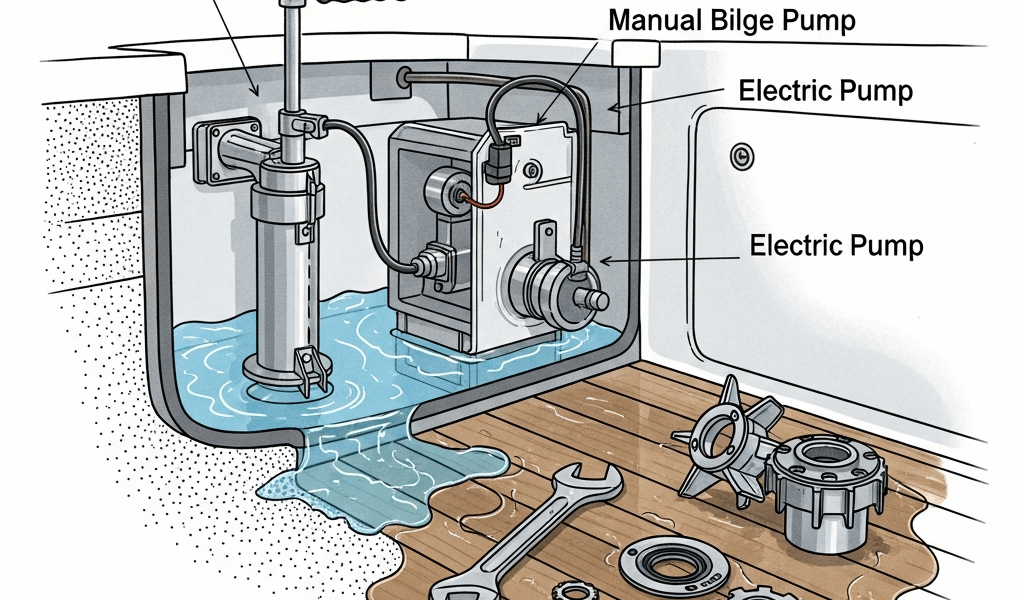
Start Here Before You Do Anything Else
A failed bilge pump can become an immediate flooding hazard. First address crew safety and the source of water, use an independent dewatering method if available, and call for assistance when inflow exceeds safe control.
First: breathe. Seriously. Most pump failures cost under $50 to fix. Before you touch a single wire, answer these three questions. You’ve got 60 seconds.
- Is the water rising visibly or holding steady?
- Can you put your hands on the manual backup pump right now?
- Is your main 12V panel somewhere you can actually reach?
Rising fast means you need to figure out whether you’re dealing with a hull breach or just a dead pump. Not the same problem. A working bilge pump — a Rule 1500, a Jabsco, whatever you’ve got — moves somewhere between 500 and 1,200 gallons per hour. A manual pump, worked hard by a tired person, moves maybe 8 to 10 gph. Do that math right now. You’ll know within a few minutes whether you have a real emergency or just a fixable annoyance.
Kill the 12V circuit breaker at your main panel before you touch any wiring. Water and electricity hate each other — and you don’t need a third problem tonight.
Bilge pump failures fall into three buckets. Float switch — that’s the most common one. Wiring, fuses, or corroded connections — second most likely. Actual motor failure — rare, but it happens. We’re going to work through them cheapest first.
Float Switch Failures and How to Spot Them
The float switch fails more than anything else on a bilge pump. But what is a float switch? In essence, it’s a simple plastic ball or cylinder that rises with the water level and triggers the pump when it gets high enough. But it’s much more than that — it’s also the thing most likely to get strangled by debris, corroded shut, or stuck in the down position for months without you knowing.
Corroded contacts. Stuck floats. A zip tie someone used to bundle some wires, drifted loose, wrapped around the stem. That last one actually happened to me. Found it on a 2019 survey of a 1987 Catalina 30 — the pump was perfectly healthy and had been sitting useless for who knows how long. Don’t make my mistake. Check the float switch first, every time.
Here’s how to test it without buying anything.
Find the float — it’ll be near the pump itself, tethered to the wire bundle. Circuit breaker still killed. Lift the float all the way up by hand. Listen for a click. Nothing? The switch is stuck or corroded internally. You hear a click but the pump never ran? Wiring is your next stop. We’ll get there.
Now do the bypass test. This is the fastest diagnostic you have.
Find the pump’s positive and negative terminals. Using a spare piece of 14-gauge wire or a set of jumper leads, connect the pump’s positive terminal straight to the positive side of your house battery. Negative to negative. No float switch involved — just raw 12V power.
Pump runs? Even weakly? Your switch is dead and your motor is fine. Pump doesn’t run at all? Keep reading. Pump runs but spits and wheezes without priming? Impeller blockage or a voltage drop problem — both covered below.
Replacing a float switch costs $30 to $80 depending on whether you grab a Rule 40A or an Attwood Sahara replacement. You can swap one out in under 15 minutes if the pump is accessible. Order the exact model number before dawn and install it when it arrives. That’s it.
When the Pump Motor Itself Has Failed
Motor failure is less common — but burned electronics have a smell. Charred plastic, slightly sweet. If you’ve smelled it once, you’ll never forget it. Check the bilge compartment for that odor before you do anything else.
Grab a multimeter. Set it to resistance — ohms mode. Touch the probes to the pump’s positive and negative terminals. A healthy motor reads somewhere between 5 and 15 ohms depending on the model. Near zero means a short. Infinity — no continuity — means the windings are burned out completely.
Run the direct battery bypass again anyway. Dead motors won’t spin even with full 12.6V sitting right there. You’ll hear a single click, maybe, and then nothing. A jammed motor might hum and strain. A burned one just sits there.
Before you order a new $65 Rule 1500 or whatever your equivalent is — check the impeller. That’s the spinning component that actually moves water through the housing. On Rule and Attwood pumps, you can get to it without pulling the entire unit out of the bilge. Hair, hose clamp debris, a single zip tie — any of it can jam an impeller solid and make the motor seem dead when it’s perfectly fine.
Pull the intake hose off the pump. Shine a light inside. See debris? Fish it out with needle-nose pliers — carefully. Don’t muscle the impeller blades, they snap easily. Once it’s clear, spin the impeller gently by hand. It should rotate freely with almost no resistance.
Reassemble. Run the bypass test again. I’d say 40% of “dead motors” I’ve seen were actually just jammed impellers. Really.
Wiring, Fuses, and Panel Gremlins
This is the frustrating category — the pump is completely fine, and nothing works anyway.
Start at your 12V panel. Find the bilge circuit breaker or fuse — most boats run a 15 or 20 amp fuse here. Blown fuse looks dark inside, sometimes cracked. Tripped breaker sits between on and off, or flops to the off side. Replace a blown fuse with the exact same amperage. Not “close.” Exact.
Blows again immediately after replacement? Stop. Something is shorting out and replacing fuses won’t fix it — it’ll just hide it. You have to trace the circuit.
Bilge wiring corrodes faster than any other 12V circuit on a boat — and that’s saying something. Heat, moisture, salt air, and constant vibration all working together. The terminals at the pump itself are where it starts. Open the bilge hatch and actually look at the wire ends. They should be shiny copper or silver. Green, white, crusty? That’s your problem.
Disconnect everything. Clean the terminals with 220-grit sandpaper or a small wire brush. Reconnect firmly with a good marinized crimp connector — not a standard automotive one. Test again.
Connections look clean? Pull a voltage test. Multimeter set to DC volts. Positive probe on the pump’s positive terminal, negative probe on ground. With the pump running or attempting to run, you want to see 12 to 13.5 volts. Below 11.5? You’ve got a voltage drop somewhere in the circuit — the pump won’t spin at full power, won’t prime properly, will seem weak and useless.
I’m apparently terrible at checking grounds — and my old Marinco wiring always lets me down while the Ancor stuff never does. Spent two full hours once chasing a phantom bilge gremlin on a friend’s Beneteau 36.7. The ground lug had worked itself loose behind the cabin sole. One 5/16-inch bolt tightened to spec and the pump ran perfectly. Don’t make my mistake. Check your ground connection before you tear apart the whole circuit.
What to Do If Nothing Works and Water Is Still Rising
Probably should have opened with this section, honestly. If you’ve run through every diagnostic above and water is still climbing, your job right now isn’t diagnosis — it’s slowing the leak and buying time.
Get to your manual pump. Every sailboat needs one — a Whale Gusher Titan or similar unit that works completely independent of the electrical system. Prime it. Start moving water. If someone else is aboard, put them on the pump while you keep troubleshooting. Manual pumping destroys your shoulders in about 20 minutes. That’s why you switch off.
Do the math again — water rising at 10 gph while you’re moving 8 gph means you’re losing. Make the call to the Coast Guard at that point. They have high-capacity dewatering pumps and people who aren’t panicking. If you’re keeping pace or barely winning, keep pumping and plan your next move once daylight hits.
Anchor in the shallowest water within reach. Sinking in 4 feet beats 40 feet — obviously. A Rule 1500 GPH pump costs about $60 and fits in a one-gallon zip-lock bag. Keep one in your spares kit permanently. When the sun comes up and you’re calmer, the options get clearer — pull the dead pump, drop in the spare, and you might actually sail out of this.
Most bilge pump failures are a midnight inconvenience, not a disaster. Fix what you can tonight. Fix what you can’t at the dock tomorrow. You’ve got this.




Stay in the loop
Get the latest sail the seas mag updates delivered to your inbox.