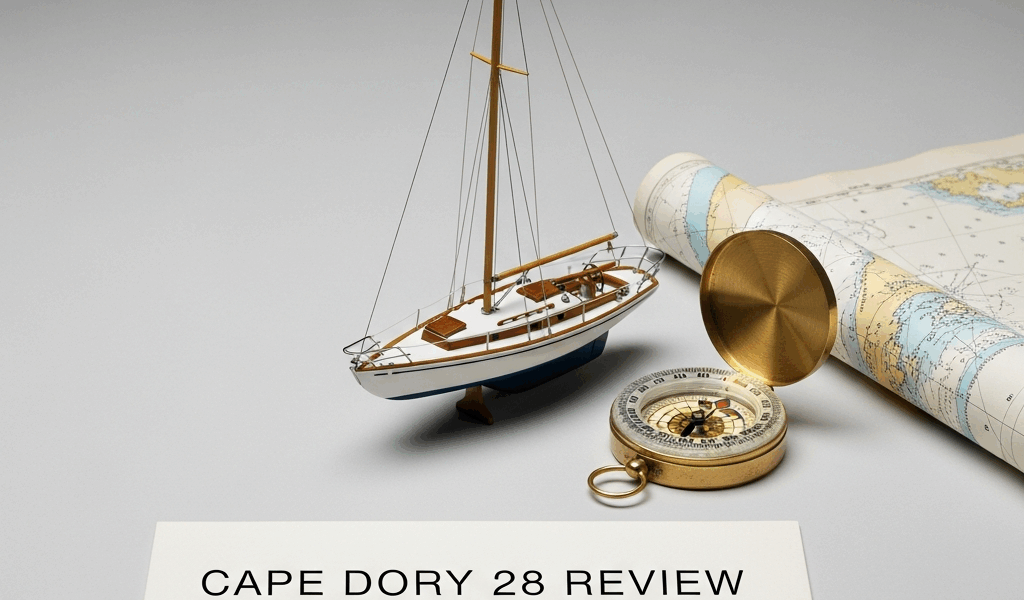
Cape Dory 28 Review — What 40 Years of Ownership Reveals
Cape Dory 28 ownership has gotten complicated with all the mythology flying around. The glowing 1978 magazine write-ups still circulate. The forum threads still devolve into arguments about anchor rode. As someone who bought my first CD28 in 2004 and spent the next two decades watching these boats sail, break, get fixed, and sell again along the New England coast, I learned everything there is to know about what makes these hulls genuinely worth owning — and where they’ll absolutely punish you for not paying attention.
Three Cape Dorys. Two 28s and a 25. Half a dozen more surveyed for friends who called me before writing checks. I know exactly where the chainplates crack, which fuel tanks rot first, and why the original Volvo MD2B sounds like a diesel washing machine full of loose change. None of that means these aren’t extraordinary boats. The love story is just complicated.
Why the Cape Dory 28 Still Has a Following
Carl Alberg designed the CD28 in 1970. A Swede trained under Knud Reimers, he understood something that modern naval architects occasionally forget — a boat’s job is to keep you alive in bad weather and get you somewhere with reasonable efficiency. Not to win races. Not to impress anyone at the marina. To work. That’s what makes the CD28 endearing to us cruising sailors who actually go offshore.
But what is a full-keel Alberg design, really? In essence, it’s a hull form that runs the keel nearly the full length of the waterline. But it’s much more than that. The full keel gives you lateral resistance without drama — she tracks straight, rounds up slowly, forgives a tired helmsman in ways that modern fin-keel designs simply don’t. The rudder hangs off the back of that keel, protected and deeply submerged. Hitting a submerged lobster pot at five knots isn’t going to blow out a rudder bearing. That matters at 2 a.m. forty miles offshore.
Cape Dory built these boats in South Dartmouth, Massachusetts from 1970 through the mid-1980s. Solid hand-layup fiberglass — no coring below the waterline on most production years. This matters enormously. Cored hulls delaminate. They absorb moisture through deck hardware over decades in ways that get catastrophically expensive. The CD28 hull is thick, heavy, essentially bulletproof if you maintain it.
Overall displacement runs around 8,200 pounds — substantial for a 28-footer. Beam is 9 feet 2 inches. Draft hits 4 feet 4 inches, which keeps a lot of anchorages accessible while still giving you meaningful keel depth. First-timers going below are always surprised — the V-berth forward is genuinely usable, the main saloon seats four without contortion, and 6 feet of standing headroom makes extended passages livable rather than miserable.
The construction quality Cape Dory maintained — consistent gelcoat thickness, quality teak trim work, solid stainless hardware — was unusual at the price point. Tartan, Bristol, and Pearson were all building comparable boats, but Cape Dory had a reputation for finishing details that actually held up. Forty years later, you can still find CD28s with original teak that just needs a cleaning and oil, not replacement. These boats lasted because they were built to last.
Known Problems Every Buyer Should Check
Probably should have opened with this section, honestly. The reputation of these boats is so strong that buyers sometimes walk aboard, fall in love with the teak and the lines, and write a check without doing the work. Don’t make my mistake. Here’s what actually goes wrong on Cape Dory 28s.
Fuel Tank Corrosion
Original fuel tanks are either black steel or aluminum depending on build year — both corrode. Steel tanks rust from the inside out after 20 to 30 years of use. Aluminum tanks pit and develop pinhole leaks at the seams when diesel with water contamination sits for long periods. Either way, the tank is typically buried under the cockpit sole, and replacing it requires significant disassembly. Figure $800 to $1,500 for yard labor, plus $300 to $500 for a custom-built poly or stainless replacement tank.
Check: pull the inspection plate, look at the tank walls with a flashlight and mirror, smell for diesel contamination in the bilge, ask when the tank was last replaced or pressure-tested. Any seller who can’t answer that question is a seller who hasn’t been paying attention.
Chainplate Stress Cracks
The chainplates on the CD28 are through-bolted to the hull liner and covered with deck-level plates bedded in sealant. After 30-plus years of rig tension cycling through wet-dry-wet New England seasons, the sealant fails. Water gets in. The fiberglass around the chainplate base develops stress cracks — in bad cases, the backing plates inside the liner start showing delamination.
Check: remove the interior headliner panels adjacent to the shroud chainplates. Brown water staining, soft spots in the liner material, visible cracking in the laminate around the bolts — any of these mean work. Rebuilding compromised chainplate bases runs $400 to $800 per side at a competent yard. New chainplates in 316 stainless, which you should do anyway on a boat this age, add another $200 to $400 depending on the fabricator.
Hull Blistering Below the Waterline
CD28 hulls are old enough that osmotic blistering is common. Not catastrophic, but expensive to ignore. Water permeates the gelcoat over years and creates small voids — pop them and you get that vinegar smell from the osmotic fluid inside. A moderate blister job on a 28-foot hull runs $2,000 to $4,000 depending on severity and whether the yard needs to barrier-coat after grinding.
Check: haul the boat before you buy it. Run your hand along the hull below the waterline — blisters feel like bubble wrap under the paint. Get the surveyor to tap the hull systematically and mark any soft spots. Non-negotiable step. Don’t skip it.
Volvo MD2B Engine Vibration and Reliability
The original power on most CD28s is the Volvo Penta MD2B — a two-cylinder, 10-horsepower raw-water-cooled diesel. It runs. It has run on boats for 40 years. It also vibrates so aggressively at low RPM that it walks itself off its engine mounts if you don’t check the mount bolts every season. Finding parts requires patience and a working relationship with a specialty marine diesel shop or a Scandinavian internet supplier.
The engine mounts themselves — Volvo part number 834101 — crack at the rubber after years of that vibration. Soft mounts don’t absorb the shaking the way a four-cylinder engine mount does. The two-cylinder firing interval is irregular and harsh. Check the mounts physically by rocking the engine by hand. Any visible cracking in the rubber or metal contact at the mount base means replacement before next season, full stop.
Quick Inspection Checklist
- Fuel tank — visual inspection and pressure test if possible
- Chainplate bases — remove headliner panels, look for staining and soft spots
- Below-waterline hull — haul and inspect for blistering
- Engine mounts — physical check for cracking and looseness
- Deck hardware bedding — especially stanchion bases and cleats, which leak onto the balsa-cored deck
- Standing rigging age — anything over 15 years old gets replaced regardless of appearance
- Keel bolts — survey should include keel bolt inspection; look for rust staining around the keel-hull joint
- Stuffing box — original stuffing boxes on these boats are often still original; check drip rate and packing age
Engine Replacement Options — Beta Marine vs Kubota
Frustrated by a complete MD2B failure in 2009 — raw water pump housing cracked, I didn’t catch it until the engine overheated entering Rockport Harbor in a crosswind with a lee shore getting closer — I spent four months researching replacement options before pulling the trigger. Here’s what I found.
The two engines that dominate CD28 repowers are the Beta Marine 14 and Beta Marine 16, and various Kubota-based marinizations. The engine compartment on the CD28 is not enormous — roughly 18 inches of usable width, 24 inches of depth — which limits your options considerably. The Beta 14 and Beta 16 are both based on Kubota D722 and D902 blocks respectively and fit the CD28 compartment without major surgery.
Beta Marine 14 and 16
Beta Marine engines come fully marinized — freshwater cooling, heat exchanger, integrated raw water pump, proper marine mounts. The Beta 14 produces 14 horsepower at 3,600 RPM. The Beta 16 gives you 16. For an 8,200-pound full-keel boat, 14 horsepower is genuinely sufficient. Hull speed on the CD28 runs around 6.5 knots, and you’ll motor comfortably at 5 to 5.5 knots on the Beta 14 at around 2,800 RPM — quiet, smooth, without vibrating your fillings loose.
The Beta 14 new runs approximately $5,500 to $6,500 depending on configuration. The Beta 16 runs about $500 to $800 more. Installation labor at a yard typically adds $1,500 to $2,500 — new engine mounts, new fuel lines, new exhaust elbow and hose, throttle and shift cables, new raw water strainer. Budget $8,000 to $9,500 all-in for a clean Beta repower done right.
What you get in return is an engine that starts cold on the first compression stroke, runs without vibration requiring a chiropractor visit, and has parts available from any marine diesel shop in North America. Beta’s customer support is apparently genuinely good — I called them directly about a fuel injection timing question on a Sunday afternoon and got a human being who actually knew the answer.
Kubota Marinizations
Some owners go directly to a Kubota industrial block and have it marinized by a local shop — typically the D722 or D902 in raw-water-cooled configuration. This costs $1,000 to $2,000 less than the Beta but requires finding a shop comfortable with the marinization process. Raw-water-cooled versions run hotter and are harder on the engine long-term compared to the freshwater-cooled Beta. Simpler and less expensive to maintain, though. Different tradeoff.
The Yanmar 2GM20 is also worth mentioning — a two-cylinder 18-horsepower engine that fits the CD28 compartment and carries an enormous parts and service network behind it. New they run around $5,000. Finding used ones from boat refit projects isn’t difficult. A used Yanmar 2GM20 with documented hours under 500 can be had for $1,500 to $2,500 — probably the budget repower option with real reliability credentials.
What She Sails Like — Honest Assessment
Ask what a Cape Dory 28 sails like and most owners say something along the lines of “she goes to weather better than you’d expect.” True — and it requires explanation, because the expectation for a full-keel 1970s cruiser is that she’ll be slow and hobbyhorsy and only comfortable running downwind. The CD28 surprises you.
Upwind in 15 to 20 knots of breeze on a close reach, she foots along at 5 to 5.5 knots and tracks without constant helm correction. The full keel acts as a damper for hobby-horsing — that pitching motion that kills speed in short chop is genuinely reduced compared to fin-keel designs. In a seaway, this matters more than almost any other single characteristic. I’ve done the run from Gloucester to Provincetown in 20-knot northwesterlies on a CD28 and arrived less tired than I had any right to be.
In light air, the limitations are real. Below 8 knots of apparent wind, the heavy displacement works against you. She doesn’t ghost along the way a lighter racing boat does — she needs wind to move. Light air summer sailing in protected water means motoring more than you’d like. Accept this and enjoy the days when the afternoon breeze actually arrives.
In rough weather, the CD28 makes its case most completely. The deep forefoot and full keel prevent the sudden lurching and rounding up that can characterize lighter, beamier boats in steep following seas. The boat stays on her feet. Not fast in rough weather — steady. Steady has a value that’s hard to overstate at 2 in the morning, 40 miles offshore, when the forecast was wrong.
Comparison to the Bristol 27 and Pearson 28
The Bristol 27 — designed by Halsey Herreshoff with a similar philosophy — is slightly lighter, slightly shorter, and a bit more tender in a breeze. The CD28 is stiffer initially and carries her form through the heel better. The Pearson 28, a centerboard shoal-draft design from roughly the same era, goes to weather less effectively and is better suited to protected-water sailing where shallow draft is actually the point. For coastal passage-making where the weather gets ugly, the CD28 outperforms both. It’s not close.
Current Market Pricing and What to Pay
The CD28 market in 2024 runs roughly $8,000 to $25,000 — and that spread represents an enormous range in actual value. Understanding what separates boats at either end of that range is the difference between a good purchase and a four-year project that consumes your weekends and your savings simultaneously.
The $8,000 to $12,000 Range
At this price point, you’re buying a project. The hull is likely structurally sound — CD28 hulls rarely become genuinely unsound — but everything else needs work. Original Volvo MD2B with unknown service history. Fuel tank that needs replacement. Standing rigging well past its service life. Deck hardware bedding that leaks. Teak that’s been neglected for years. Old running rigging throughout.
A $10,000 boat might need $8,000 to $12,000 to reach competent sailing condition. Know that before you buy it. These are not boats you purchase and sail away from the slip the following weekend without work.
The $15,000 to $22,000 Range
This is where the turn-key and near-turn-key boats live. A CD28 in this range should have a repowered engine — Beta or Yanmar within the last 10 years — new standing rigging, replaced fuel tank, and a current survey. Cosmetics should be presentable, running rigging serviceable, sails adequate even if not new.
The best values here are boats owned by sailors who actually use them. Systems get tested, problems get found and fixed, maintenance doesn’t get deferred for five seasons. Be suspicious of boats that have sat on the hard for three or four years even at this price point — sitting kills boats. Gaskets dry out, fuel systems gum up, and nothing substitutes for regular use.
What to Actually Pay
For a boat with a repowered Beta or Yanmar, new standing rigging installed within five years, replaced fuel tank, no blister work needed, and a survey that comes back clean on chainplates and keel bolts — $18,000 to $22,000 is appropriate. Genuine value for a blue-water-capable cruising boat. For comparison, a new Catalina 275 Sport lists at $65,000 and will not be sailing in 40 years.
For a project boat with a running but tired


Stay in the loop
Get the latest sail the seas mag updates delivered to your inbox.