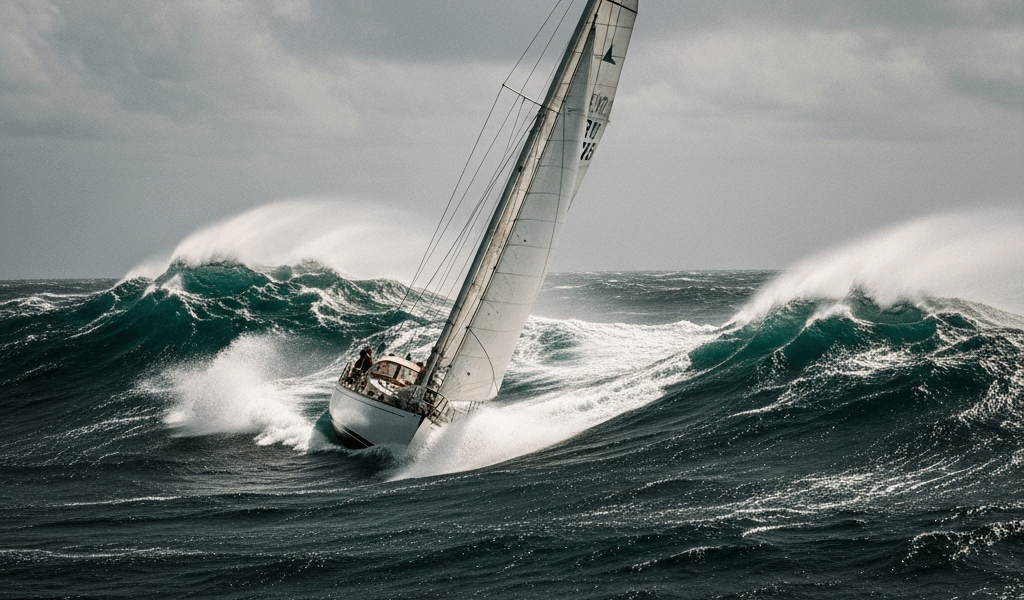
In August 1979, 303 boats started the Fastnet Race from the Solent in England. A Force 10 storm hit the fleet in the Irish Sea with 60-knot winds and 40-foot breaking waves. Fifteen sailors died. Twenty-four boats were abandoned. Five sank. Among the boats that kept sailing, refused to be rolled, and finished the race was a Contessa 32 — a boat so well-designed that it became the benchmark for offshore seaworthiness in the decades that followed.
What Happened at the 1979 Fastnet
The Fastnet Race runs from Cowes on the Isle of Wight around Fastnet Rock off southern Ireland and back to Plymouth — 608 nautical miles through open water. The 1979 race started in fair conditions that deteriorated rapidly as an unexpected low-pressure system deepened faster than forecasters predicted. By August 14th, the fleet was caught in the worst storm to hit the race in its 54-year history.
The conditions were extraordinary. Sustained winds hit 60 knots with gusts above 70. Seas built to 40 feet with breaking crests that rolled boats completely over. The combination of wind against tide in relatively shallow water created confused, steep waves that made conditions even more dangerous than the wind speed alone suggested.
Larger boats with experienced crews fared better in general, but the storm did not discriminate cleanly by size. Several large boats were abandoned or sank. What separated the boats that survived from those that did not came down to hull design, build quality, and crew decisions — and the Contessa 32 excelled on all three counts.
Why the Contessa 32 Survived
The Contessa 32 was designed by David Sadler and built by Jeremy Rogers Ltd in Lymington, England. At 32 feet on deck, it is not a large boat. But it was designed with a set of hull characteristics that turned out to be almost perfectly suited to surviving heavy weather offshore.
The hull shape tells the story. The Contessa 32 has a moderately heavy displacement (10,000 lbs) for its length, giving it the mass to resist being tossed by breaking waves. The waterline beam is narrow relative to the deck beam, which means the hull’s center of gravity sits low and the boat has powerful self-righting ability. If rolled, the ballast-to-displacement ratio pulls it back upright. During the Fastnet storm, multiple Contessa 32s were rolled 90 degrees or beyond and came back up with masts intact.
The long keel with an attached rudder provides directional stability that a fin-keel boat with a spade rudder cannot match in extreme conditions. When a breaking wave hits a fin-keel boat broadside, the short keel can lose grip and the spade rudder — hanging unsupported behind the keel — is vulnerable to damage. The Contessa 32’s keel runs nearly half the boat’s waterline length, and the rudder is protected by the trailing edge of the keel. In survival conditions, this is the difference between a boat that holds its course and one that broaches uncontrollably.
Build quality was exceptional. Jeremy Rogers built the Contessa 32 with hand-laid fiberglass that was heavier and stronger than production norms of the era. The deck-to-hull joint is bolted and bonded — redundant fastening that holds when one system fails. The companionway and cockpit were designed with small openings and high coamings, making it difficult for breaking seas to flood the interior. Small details like this — cockpit volume, hatch size, drain capacity — determine whether a boat survives a knockdown or fills with water and sinks.
The Contessa 32 Today
Production of the Contessa 32 ran from 1971 to the early 2000s, with approximately 700 hulls built. The boat remains one of the most sought-after used sailboats for offshore cruising and blue-water sailing. Prices for well-maintained examples range from $30,000 to $80,000 depending on condition, equipment, and refit history.
The boat has limitations that are honest to acknowledge. The interior is compact — a 32-foot waterline does not provide spacious living quarters by modern standards. Headroom below is limited, the galley is functional but small, and privacy for two couples is minimal. The rig is a masthead sloop that is efficient but not as versatile as a cutter rig for heavy-weather sailing at reduced sail. Performance in light air is moderate at best — the heavy displacement that makes it safe in storms makes it slow in 8 knots of breeze.
But no one buys a Contessa 32 for light-air performance or interior volume. You buy it because it is a boat that was proven in conditions that destroyed larger, newer, more expensive boats. The 1979 Fastnet cemented its reputation, and nearly five decades later, that reputation has only grown. Among sailors who cross oceans, the Contessa 32 remains shorthand for a boat you can trust when the weather turns genuinely dangerous.
What the Fastnet Taught the Sailing World
The 1979 Fastnet disaster triggered a complete reassessment of offshore racing safety. The Royal Ocean Racing Club investigation found that many boats were abandoned prematurely — crews took to life rafts when their boats were still floating and survivable. Several sailors died in life rafts while their abandoned boats were later found still afloat.
The inquiry also confirmed what the Contessa 32’s survival demonstrated: heavy displacement, moderate beam, and strong self-righting ability matter more in extreme conditions than speed, light weight, or interior volume. The trend in yacht design toward lighter, beamier hulls optimized for racing performance came at a cost in ultimate seaworthiness — a cost that was invisible until the storm hit.
The lesson is still relevant. Modern production cruisers are wider, lighter, and more comfortable than the Contessa 32. They are also, in most cases, less capable in survival conditions. For coastal sailing and fair-weather cruising, it does not matter. For crossing oceans or sailing in waters where heavy weather is a certainty rather than a possibility, it matters enormously.


Stay in the loop
Get the latest sail the seas mag updates delivered to your inbox.