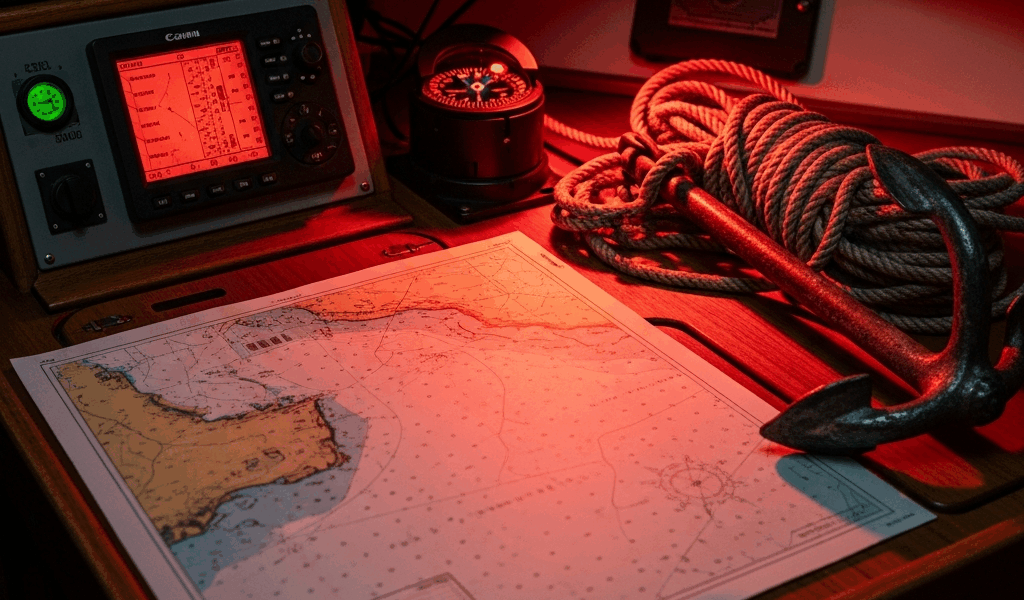
How to Tell If Your Anchor Is Actually Dragging
Anchor dragging at night has gotten complicated with all the conflicting advice flying around. As someone who’s spent seasons anchoring everything from a 28-foot sloop to a 42-foot ketch in conditions ranging from glassy calm to 35-knot squalls, I learned everything there is to know about the difference between a boat that’s dragging and a boat that’s just doing its normal thing. Today, I will share it all with you.
But what is anchor dragging, exactly? In essence, it’s when your anchor loses its grip on the bottom and your boat moves freely across the water. But it’s much more than that — it’s a crisis unfolding in slow motion while you’re asleep. Normal swinging happens in a controlled arc around a fixed point. The rode stays taut. The angle to shore objects stays consistent. Dragging feels like lateral drift. No fixed point. No controlled arc. Just a boat sliding somewhere it shouldn’t be going.
Here are the three detection methods that actually work:
- Visual bearing method: Pick two fixed objects on shore — a tree, a dock light, a building corner — that form a clear sightline from your cockpit. Before sleep, take a bearing on both. Write it down, physically, on paper. If that bearing changes over the next two hours, you’re dragging. If it stays identical, you’re swinging safely within your scope circle. This method costs nothing and works in any weather.
- GPS anchor alarm apps: Anchor Watch — available on iOS and Android for around $5.99 — and Garmin ActiveCaptain both let you set a radius around your drop point. I use a 30-meter alarm radius as my baseline. Anything tighter than 25 meters triggers false alarms from normal swing. Anything wider than 40 meters means you’ve already drifted far enough that you should know something is wrong without any app telling you. The app sends an alert the moment your GPS position crosses that circle boundary.
- Physical feel: This one requires experience and honesty. When you’re anchored correctly, the rode transmits a constant, gentle tension through the bow. You feel it in the cleat, in the deck itself — a subtle tautness that hums. Dragging feels different. The rode goes slack for a beat, then snaps taut again as you drift further and scope plays out. It’s rhythmic. Unsettling. Once you’ve felt it, you never forget it.
Probably should have opened with this section, honestly. The most expensive mistake I ever made at anchor came from confusing a three-knot swing with actual drift. I’m apparently a heavy sleeper, and checking bearings never happened that night. By the time I woke to my bow pulpit scraping another boat’s forestay at 2 a.m., we’d dragged nearly 150 meters. Don’t make my mistake. Set the alarms. Check the bearings. Trust the instruments.
Immediate Steps When You Realize You Are Dragging
The moment you know you’re dragging — whether from a phone screaming at you or that sickening slack-and-snap sensation through the hull — forget everything except engine start.
Do not pull up the anchor. Do not assess anything from the cabin. Do not wake the crew gently. Start the engine. Immediately. This is the one non-negotiable first move. A diesel turning over in four seconds beats a Danforth pulling free in four minutes, every single time.
As soon as the engine catches, send someone to the bow. They need to watch the rode — its direction and tension. Are other boats nearby? How much swinging room exists between you and the nearest hull? Is the rode leading forward or off to the side? That person becomes your eyes on the problem while you’re at the helm managing position.
The decision to pay out more scope or motor up and re-anchor depends on three things: how much water you have under the keel, whether other boats occupy your new drifting path, and how much actual holding ground exists below you. In many situations, paying out an additional 10 or 15 meters of rode buys the anchor time to re-set into firmer bottom. Reduced pull angle means better holding — sharper angles are the enemy.
But if you’re dragging toward moored vessels — which is where this becomes a genuine crisis — you motor up slowly. Idle speed. Keep the rode taut. Get directly above the anchor, then work backward on idle, letting the engine hold position while the anchor finds its bite again. Most sailors gun it. They re-set aggressively, the anchor catches hard, and the boat lurches into a new problem. Patience here is everything.
Once the boat settles and you’re holding position, figure out what actually failed. Wind shift? Insufficient scope? Something fouled the flukes? Only after those questions have real answers should you think about moving to a better spot.
Why Anchors Drag and What Bottom Types Matter
Four situations cause the vast majority of drag events: insufficient scope, poor holding ground, a sloppy initial set, and sudden load shifts when wind direction changes. That’s it. Four things.
Scope ratio is the relationship between water depth and the length of rode you’ve deployed. A 5:1 ratio holds fine in calm conditions. Twenty knots of wind requires 7:1 minimum. Storm conditions demand 10:1 — and honestly, if a storm warning exists and you’re anchored in an exposed bay, you should already be gone before any of this matters.
I use this simple table before I drop anchor:
- Calm conditions, good holding: 5:1 scope
- Moderate wind (15–20 knots), firm bottom: 7:1 scope
- Strong wind (20+ knots), any uncertainty: 9:1 scope
- Approaching storm, exposed anchorage: Weigh anchor and leave
Bottom type determines everything else. Grass and weed create terrible holding for most anchors — but excellent holding for plow-style designs like the CQR, and modern options like the Rocna or Mantus, which dig through grass into the mud beneath. Hard sand holds plow-style anchors beautifully but turns treacherous for lightweight designs. Rock and shell hold nothing reliably. I avoid those bottoms entirely, full stop.
The initial set matters more than most sailors admit. After you drop the anchor and back down, motor backward slowly under load — roughly 1,500 RPM in reverse — to confirm the anchor is digging, not skidding along the bottom. You’ll feel the boat pull differently once it sets hard. That sensation is unmistakable. Most re-grabs and second-anchor situations happen because nobody bothered testing the first set.
How to Re-Anchor Safely After a Drag
You’ve secured position. Engine is running. Crew is awake and unhappy about it. Now comes the re-anchor. So, without further ado, let’s dive in.
Pick your new spot with swinging room as the primary criterion — not convenience, not proximity to the beach, not Wi-Fi signal from the marina. Calculate 360 degrees of free swing at maximum scope. An anchorage that looked fine at 5:1 might become dangerously tight at 7:1. Account for other vessels already anchored and their scope. Your 38-footer parked next to a 65-foot motor yacht just became neighbors in a much smaller circle than you think.
Motor slowly toward the new location while watching your depth sounder. Find a spot with consistent bottom — all mud or all sand, not transitions between the two. Depth should increase slightly as you approach so the anchor loads progressively as scope pays out, not all at once.
Let the old anchor come up cleanly before repositioning. Don’t drag two anchors across an anchorage. When the old one breaks free, pause the boat for 30 seconds, confirm the chain is fully aboard, then proceed.
Drop the anchor with proper technique. Back down slowly at idle, applying steady load. Once scope reaches target — say, 35 meters in 5 meters of water — engage reverse at 1,500 RPM for 30 seconds. Feel the boat settle and pull against the hook. Wait two full minutes. Then take new bearings on shore objects and reset your GPS alarm radius to the new position before anyone goes back to sleep.
Anchor Watch Setup That Catches Problems Early
The best defense against a nighttime drag crisis is detecting it before it becomes a crisis. That’s what makes a layered watch system endearing to us short-handed sailors.
While you won’t need a dedicated offshore watch system for a quiet anchorage, you will need a handful of overlapping tools working together. Set your phone GPS alarm — Anchor Watch is reliable, $5.99, worth every penny — with a 30-meter radius before bed. Set it to vibrate if you’re a light sleeper. I’m apparently a vibration-waker, and that setting works for me while audio alerts at 3 a.m. never quite punch through the way you’d expect.
Use your anchor light correctly. Visible 360 degrees, mounted high, on all night. Not as drag detection — it won’t tell you anything about that — but as a courtesy to other vessels that might otherwise drift toward you in the dark without ever seeing you.
Before sleep, take updated bearings on at least two fixed objects and record them. Set a phone reminder to recheck those bearings at midnight and again at 4 a.m. for longer overnights. Most dragging happens in the first few hours after anchoring or during the wind shifts that roll through after midnight. That pattern is remarkably consistent.
Dedicated anchor drag alarms — the Watchmate runs $400 to $600, and integrated Garmin GPSMap anchor alarm features offer solid redundancy beyond phone apps — might be the best option for exposed anchorages, as the conditions there require reliable redundancy. That is because a phone battery dying at 2 a.m. is a real scenario, not a theoretical one. Redundancy saves boats.
The real solution, though, lives in the initial choice. Frustrated by one too many midnight scrambles in marginal anchorages, I started spending an extra hour motoring to find genuinely protected spots with firm mud bottom. A cove with 10 boats already swinging comfortably beats an exposed sandy bay every time, regardless of what alarm systems you’ve rigged up. This new habit took hold after one particularly ugly night in the Chesapeake — 2019, blowing 28 knots by 3 a.m. — and eventually evolved into the pre-anchor routine experienced sailors know and rely on today. Prevention is the only response that never fails.



Stay in the loop
Get the latest sail the seas mag updates delivered to your inbox.