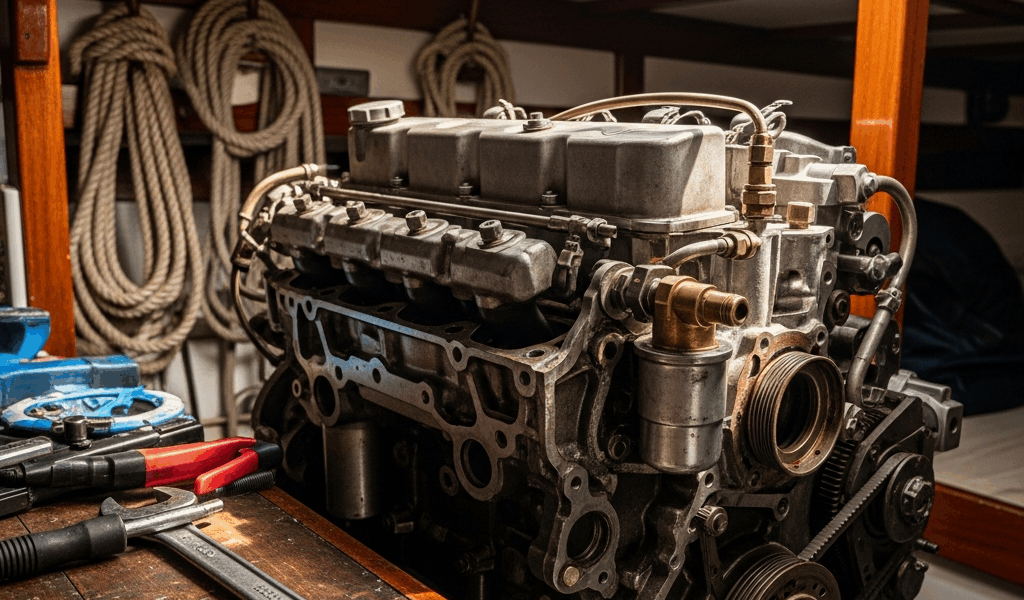
Sailboat Diesel Engine Won’t Start — Troubleshooting Steps
Diesel troubleshooting has gotten complicated with all the conflicting advice flying around online. As someone who’s maintained charter boats and personal sailboats for fifteen years, I learned everything there is to know about marine diesel no-starts the hard way. Today, I will share it all with you.
Most of the time? Stupidly simple problem. A closed valve. A dead battery. Something you’ll kick yourself over. But you won’t know until you actually run the checklist — and run it in order, not randomly. This is what I wish I’d had laminated inside my cabin door before my first engine failure on a 27-foot Pearson, sweating through my shirt at 7 a.m. while the marina filled up around me.
The 3-Minute Check Before You Panic
Start here. Non-negotiable.
I once spent two hours troubleshooting a Yanmar 2GM20F — checking fuel lines, testing terminals, muttering at the engine — before realizing the kill switch was sitting in the OFF position. The owner had flipped it during winter layup and completely forgotten. Two hours. Don’t make my mistake.
Kill Switch and Control Panel
Walk to your engine panel. Find the kill switch — usually a red button or lever mounted near the throttle — and push or toggle it firmly to ON. Older systems run a cable-driven kill switch that can jam halfway, giving you a false sense that it’s engaged when it isn’t.
While you’re standing there, work the throttle cable. Pull the handle fully out, push it all the way back in. Smooth resistance is what you want. Grinding or binding means a seized cable — it won’t stop you starting the engine, but it’ll stop you running it, which is its own problem.
Fuel Shutoff Valve
This one gets skipped constantly. Your fuel shutoff valve lives between the tank and the fuel filter — a ball valve right on the fuel line, usually visible without removing anything. Handle parallel to the line means open. Handle perpendicular means closed. That’s it.
I once stood next to a boat owner for twenty minutes while we tested connections, checked voltage, consulted the manual — and then watched him rotate a ball valve a quarter turn and have the engine fire immediately. He’d closed it when cleaning the fuel tank. Hadn’t thought about it since. Twenty minutes.
Battery Voltage
Grab your multimeter. A resting marine battery in good shape reads around 12.6 volts. Turn on the cabin lights and actually look at them. Dim and yellowish, plus a weak clicking when you hit the key — that’s a discharged battery. Complete silence with no clicks at all means it’s fully gone.
Turn the key to START and watch your voltmeter reading. Anything dropping below 9.5 volts during cranking means the battery can’t support the starter draw. Diesel starters pull 300 to 500 amps — they’re brutal on weak batteries. That’s a power problem, not a mechanical one. Worth separating early.
Fuel System — The Most Common Culprit
Probably should have opened with this section, honestly. Forty percent of no-start calls I’ve dealt with traced back to fuel. Maybe more. Your sailboat’s fuel system is more fragile than you think — especially if you run the tank low or cruise anywhere warm.
Air in the Fuel Lines
Drop below a quarter tank and you’re gambling. Heavy boat motion combined with a low fuel level can suck air into the pickup line. Once that happens, the engine won’t fire — diesel fuel lines need to be completely liquid, not a mix of fuel and air pockets.
Bleeding the system fixes it. But what is bleeding? In essence, it’s purging trapped air from the fuel lines until clean diesel flows through. But it’s much more than just cracking a screw — you need to do it in the right sequence or you’ll just introduce more air.
- Find the bleed screw. On a Yanmar, it’s typically on the secondary fuel filter housing. Check your engine manual for your specific model — this matters.
- Put a small container underneath. You’ll catch maybe a cup of diesel, so plan accordingly.
- Loosen the bleed screw a quarter turn — by hand or with a wrench, depending on how seized it is.
- Key to ON, but don’t crank. Your electric fuel pump should prime automatically. Listen for a faint whirring sound.
- Watch the bleed point. When steady, bubble-free diesel appears, snug the screw back down hand-tight.
- Key to OFF. Wait 30 seconds.
- Try the engine.
No fuel appearing after 30 seconds means your electric fuel pump might have failed. That narrows things down considerably — and it’s a separate repair entirely.
Fuel Filter Inspection
But what is a clogged fuel filter doing to your engine exactly? In essence, it’s strangling fuel flow before it reaches the injectors. But it’s much more than just a slow-start problem — a badly clogged filter can prevent starting entirely, or cause the engine to almost catch and then die repeatedly.
Access the filter — usually mounted on or very close to the engine block. Look for a metal or clear plastic bowl with a drain plug at the bottom. Loosen the drain plug slightly with a container ready. Clean diesel should run out. Cloudy liquid or anything that separates into layers means water contamination. Let it drain for a full minute by gravity, then tighten the plug and pull the filter element.
Most unscrew by hand. Some need a filter wrench — the $8 strap type works fine. Replace the element, then re-prime the system using the bleed procedure above. Filter elements run $20 to $60 depending on your engine. A Yanmar 2GM takes a standard spin-on style, easy to find at any marine supply. Doing this yourself saves the $150 minimum service call a mechanic charges just to show up at your slip.
Diesel Bug in Warm Water
I’m apparently very sensitive to this problem — I cruise subtropical water regularly and Biobor JF works for me while leaving tanks untreated never does. If your fuel has been sitting in a warm tank for several months, you might be looking at microbial contamination. Black, sludgy material at the bottom of the tank. The smell is distinctive — sour, almost organic.
That sludge clogs filters fast. You’ll replace one, run the engine for ten minutes, and watch it clog again. Treatment with Biobor JF handles the biology, but you’ll cycle through multiple filters as the treated sludge mobilizes. Prevention is simpler — fresh fuel, full tanks in hot weather, and a sealed fill cap to block water ingress.
Electrical System Diagnosis
Salt spray, vibration, moisture — your electrical connections are fighting all three simultaneously. That’s what makes marine electrical troubleshooting so endearing to us sailboat owners. A car connection lasts a decade. A boat connection starts corroding the moment you leave the dock.
So, without further ado, let’s dive in.
Battery Under Load
A battery reading 12.6 volts at rest can collapse completely the moment a starter motor demands current. This is the most common misdiagnosis I see — owner checks voltage, sees a fine number, rules out the battery, and spends three hours chasing a problem that doesn’t exist.
Real test: Flip on the cabin lights. Hit the starter. Watch the lights — not the voltmeter. If they go nearly dark during cranking, your battery can’t sustain load. A healthy battery shows a slight flicker, nothing dramatic.
Diesel starters need 300 to 500 amps. Your battery should be rated at 800 CCA minimum — at least if you want reliable cold starts on anything bigger than a 15-horsepower Yanmar. Most house batteries on used sailboats are five to ten years old and operating at half capacity from years of partial charging. That’s your culprit more often than not.
Check the terminals while you’re there. White, blue, or green crystalline buildup around the posts adds enough resistance to starve the starter. Mix baking soda and water, loosen the cable clamps, scrub the post and the inside of each clamp with a wire brush, rinse, and retighten. That fix alone has solved probably 15 percent of no-start calls I’ve handled over the years.
Solenoid Click Test
Turn the key to START and listen. One loud, solid click followed by nothing — the starter motor itself has failed. The wiring is doing its job. The mechanical starter is dead. Multiple rapid clicks mean the battery can’t fully energize the solenoid. No click at all points to a dead battery, broken ignition switch, or corroded connection somewhere in the circuit.
One solid click followed by cranking but no firing — that’s different. That’s fuel or compression territory, not electrical. The distinction matters because the next steps split completely at that point.
Glow Plug Function
Key to ON, but don’t crank yet. A yellow coil-shaped indicator light should appear on your panel. It stays lit for 5 to 15 seconds, then goes out — that’s the glow plugs heating the combustion chamber. Start during or immediately after that cycle.
No glow indicator at all suggests your alternator isn’t keeping the battery charged. A nonfunctional alternator kills glow plug performance within a handful of engine starts. One failed glow plug on a multi-cylinder engine won’t stop you from starting — it makes cold starts harder, though. Engine fires fine in July but struggles in November? Suspect glow plugs. Replacement runs $40 to $200 depending on cylinder count and how buried they are in the engine compartment.
Compression and Mechanical Issues
Compression problems are rarer than fuel or electrical issues. They’re also the ones that hurt your wallet the most. Still — you need to rule them out.
Decompression Lever
Older sailboat diesels often have a decompression lever on the engine block — a mechanical device that holds the exhaust valve slightly open to make hand-cranking easier. Frustrated by stuck engines on early boats, engineers added this feature using a simple external lever mechanism. This new idea took off several decades later and eventually evolved into the hand-start backup system enthusiasts know and rely on today.
If that lever is stuck in the ON position, your engine has virtually no compression and won’t start regardless of what else you do. Find it, confirm it’s in the OFF position, turn the engine over once manually if you have a hand crank, and try starting normally.
Cold Weather Challenges
Diesel fuel thickens when cold. Northern moorings, winter cruising, early spring departures — fuel that sat in a half-empty tank overnight can be sluggish enough to restrict flow. Most marine diesel is rated down to 0°F, but paraffin content varies by refinery and region. Your fuel might gel at 20°F even if the spec says otherwise.
Diesel 911 is the quick fix — a $15 bottle added to the tank. Switching to winter-blend diesel before cold weather arrives is the smarter move. Keep tanks at least three-quarters full during cold months to reduce the air space where condensation forms.
Lack of Compression — The Bad News
Battery confirmed good. Fuel flowing. Glow plugs cycling. Engine still won’t fire — or won’t even turn over properly. That’s an internal compression problem. Stuck valves, broken piston rings, damaged head gasket, or a timing belt that’s jumped a tooth. None of these are dockside repairs.
A diesel compression gauge screws into the glow plug hole and costs around $50. It’ll confirm your suspicion. But honestly, if you’ve gotten this far through the checklist and found nothing, call a marine mechanic. Compression work means pulling the cylinder head at minimum. That’s a workshop job — $2,000 to $8,000 depending on what’s actually wrong and what engine you’re running.
When to Call for a Tow vs. Fix It Yourself
Run the checklist above and you’ll know exactly where you stand. That knowledge alone is worth the 30 minutes.
What You Can Safely Fix Yourself
Corroded battery terminals — clean them. Closed fuel shutoff valve — open it. Air in the fuel lines — bleed them. Clogged fuel filter — replace it. These are 15-to-60-minute jobs with hand tools and no specialized knowledge required.
While you won’t need a full marine toolkit, you will need a handful of basic items — a metric socket set, combination wrenches, a multimeter, and maybe a strap-style filter wrench. Total investment: $40 to $100 if you’re starting from nothing. Worth every cent.
Injector and Timing Problems
Engine cranks normally, sounds healthy, but absolutely refuses to fire — no coughing, no smoke puff, no hesitation. That’s injector or timing territory. Diesel injectors operate at 3,000 to 4,000 psi. Testing spray patterns requires equipment you don’t have on the boat. Timing adjustments demand precision that comes from specific engine training.
A marine diesel mechanic runs $100 to $150 per hour. Full injector service costs $200 to $600 per injector — at least if you’re running a newer common-rail system. Timing diagnosis and adjustment might be $300 to $500 additional. A tow to a proper yard runs $200 to $400 depending on distance. The math usually favors the tow if you’ve genuinely ruled out everything else.
Internal Engine Failure
Seized valves. Broken rings. Blown head gasket. These failures announce themselves — the engine suddenly becomes extremely hard to turn over by hand, or compression disappears after the engine was running perfectly fine. Engine replacement on a sailboat runs $5,000 to $15,000 installed, depending on horsepower and model availability.
That’s what makes systematic diagnosis so endearing to us sailors who like keeping money in our pockets. Spending 30 minutes at the dock before calling anyone has never once been a decision I regretted. Calling a mechanic for a closed shutoff valve — that happened once. Once was enough.
Work through the steps. Document what you find. You’ll either have the engine running before noon, or you’ll hand a mechanic a clear problem description that cuts their diagnosis time — and your bill — in half.




Stay in the loop
Get the latest sail the seas mag updates delivered to your inbox.