Why Rigging Fails and When It Matters Most
Sailboat rigging inspection has gotten complicated with all the checklists and YouTube walkthroughs flying around. Most of them miss the point entirely.
As someone who lost a starboard upper shroud fifty miles southeast of Cape Fear, I learned everything there is to know about what rigging failure actually looks like. Today, I will share it all with you.
The wire didn’t snap cleanly — it peeled. My 1985 Catalina 38 had a swage fitting cracked at the base, hidden under two seasons of salt spray and my own laziness. A 22-knot squall finished the job. The mast stayed up, barely. But ten minutes of one-handed sailing while I scrambled to rig a temporary lower shroud taught me more than any inspection guide ever had. Most failures are predictable. You see them coming — at least if you know what you’re looking at.
But what is rigging failure, really? In essence, it’s metal and rope surrendering to forces they’ve absorbed for years without complaint. But it’s much more than that.
Three mechanisms do the damage. Fatigue from constant movement hammers swage fittings and wire terminations year after year — tiny oscillations, invisible to the naked eye, cracking metal incrementally. UV exposure and crevice corrosion attack stainless steel and aluminum under fittings, inside furling drums, anywhere moisture pools without drying. And chafe simply grinds through running rigging wherever sheets cross themselves or press against spreaders at an angle. That’s it. Three killers.
This matters most before any bluewater passage. Not because every failure ends in disaster. The forestay, upper shrouds, lower shrouds — those are the ones that determine whether your mast stays vertical. Two hundred miles offshore, a mast failure isn’t a bad afternoon. It’s a potential catastrophe. That’s what makes rigging inspection endearing to us offshore sailors. It’s boring, methodical work that occasionally saves lives.
So, without further ado, let’s dive in.
Split your rigging into two families first. Standing rigging holds the mast in compression and tension — stays and shrouds. Running rigging controls sails — halyards, sheets, control lines. Standing rigging fails slowly, then catastrophically. Running rigging fails at chafe points and betrays you exactly when you need it most.
Standing Rigging Inspection From Deck to Masthead
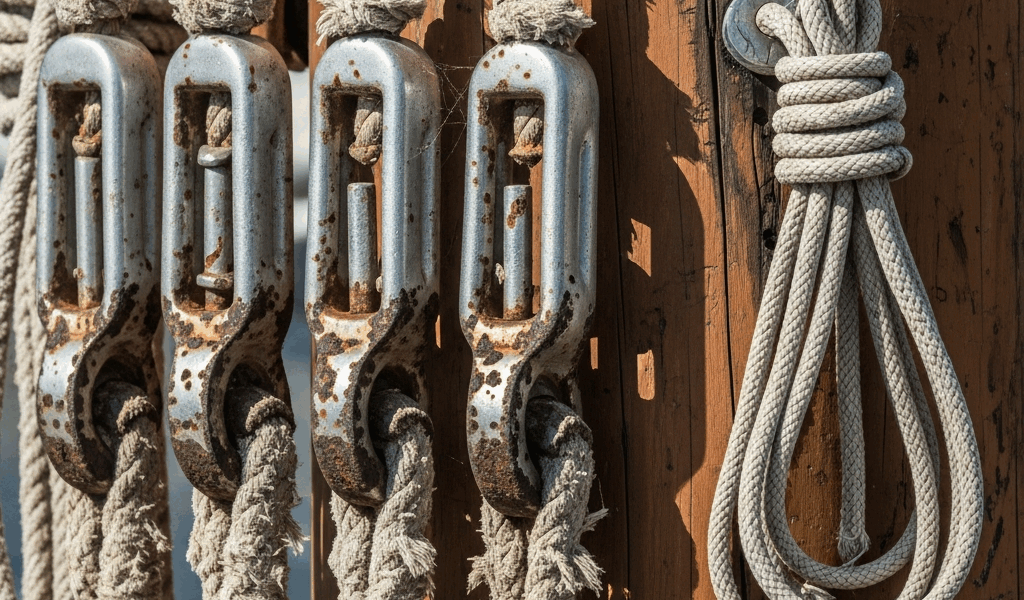
Start at deck level. Every swage fitting — the terminal points where wire rod crimps into stainless steel — deserves a close look. Grab a magnifying glass. This is not optional. Your eyes alone will miss what matters.
Cracking appears as hairline splits radiating outward from where the wire enters the fitting. On 1×19 wire, individual strands can separate slightly when a swage is failing. A dental pick — yes, an actual dental pick, the kind your hygienist uses — lets you probe around the fitting base. If the pick catches anywhere, or if you feel any movement at all, that swage is compromised. Riggers call these catches “meat hooks.” They’re a death sentence for the fitting.
Toggle alignment is something most sailors underestimate. Toggles are hinged connections between shrouds and chainplates. Under load, they should hang straight. Look at them under sail tension. A toggle cocked sideways loads the swage fitting off-axis, which accelerates fatigue dramatically. If the toggle won’t center, the problem usually lives in the clevis pin — the horizontal bolt connecting toggle to chainplate. Check it for wear. The pin should be tight. Any wiggle means replacement time. Clevis pins cost about $8 at a rigging shop.
Cotter pins secure clevis pins. These small split-ring pins corrode or go missing more often than you’d think. A missing cotter pin isn’t immediately catastrophic, but the clevis pin can work loose and that toggle loses center fast. Carry spares. They cost forty cents each. Don’t make my mistake of running a full season without checking them.
The forestay and upper shrouds absorb the most abuse. Run your gloved hand along the entire length of each one — you’ll feel corrosion spots, nicks, and separating wire that your eyes would pass right over. Any nick penetrating more than a quarter-inch into the wire diameter means calling a rigger. That wire has lost structural integrity at that point and isn’t coming back.
Rod rigging — carbon or stainless rod instead of conventional wire — requires a completely different mindset. Rod doesn’t fray before it fails. It cracks internally and snaps without warning. You won’t see it coming. Annual professional inspection isn’t optional for rod-rigged boats. The inspection runs maybe $300 to $500. A mast failure runs $15,000 to $40,000. The math isn’t complicated.
Probably should have opened with this section, honestly. Most sailors skip chainplate inspection entirely and jump straight to shrouds. Don’t make my mistake.
Chainplates and Deck Penetrations
Chainplates are where standing rigging meets the hull. They’re bolted through the deck. They’re also where stress concentrates most aggressively — and a bad chainplate failure can take deck laminate with it, opening water intrusion problems that don’t fully reveal themselves for months and then suddenly cost thousands to fix.
Modern chainplates have backing plates under the deck. Older production boats from the 1980s — Catalinas, Hunters, C&C models — often had minimal backing by today’s standards. Go below. Find the headliner directly beneath each shroud and stay attachment point. Rust stains? Water marks? Soft spots in the wood around the bolts? Any of those indicate movement or chronic moisture intrusion. Neither is acceptable.
From the deck, look at each chainplate directly. Flush against the deck? Push down on it firmly with your palm. Any movement — any at all — means the bolts are loose or the backing plate is compromised. This isn’t a check you do under sail. This is a static, boat-at-rest, full-body-weight check. The fitting should feel like it’s part of the boat. It should not flex.
Fiberglass decks are vulnerable to what riggers call pull-through — the chainplate working through the laminate under repeated load cycles. The warning sign is a stress ring of white cracking radiating outward from the fitting base. Hairline cracks? Monitor them closely, monthly. Cracks visible without magnification? The backing plate is failing and you need structural reinforcement before the next passage.
Stainless steel chainplates corrode. I know that sounds wrong — stainless steel is supposed to resist corrosion. But crevice corrosion happens where stainless bolts meet fiberglass and trapped salt water, and it’s relentless. Check bolt heads for white or gray corrosion products. If you find them, remove the bolt and inspect the shank directly. Pitting means replacement. Not monitoring. Replacement.
Running Rigging: What Wears Fastest and Why
Running rigging fails through chafe — almost exclusively. Halyards rubbing against spreaders, sheets crossing themselves at the genoa car, topping lifts grinding where they contact spreader tips. These are the failure points. Everything else is secondary.
Inspect halyards by pulling them down under tension and running your hands along every inch of the full length. Flat spots, fuzzy texture, any change in feel — that indicates core damage. Synthetic halyards, Spectra and Dyneema especially, can look completely fine externally while the core has already separated inside. When the core fails, the halyard no longer holds load reliably. I’m apparently hard on halyards and Dyneema works for me while braided polyester never survives more than three seasons. For halyards older than ten years on an active boat, replacement is maintenance, not repair.
Furling systems deserve specific and methodical attention. The forestay furling drum bearing is a common failure point that catches sailors off guard. Hard to roll or unroll? The bearing is binding. Squeaking or groaning when you furl? That’s metal-on-metal contact — the bearing is actively failing. A squeaky furl in the marina becomes a stuck furl offshore, and a stuck furl at sea is an emergency with no good options.
Inspect the furling line for chafe at two points: where it wraps around the drum, and where it leads aft through deck blocks. The line should run freely through every lead. Any stiffness or resistance means chafe has started. A replacement furling line for a Harken or Schaefer system runs $200 to $400. A stuck furler 150 miles offshore costs far more — in stress, seamanship, and potentially in sail damage.
Boom vangs and topping lifts wear at terminations. The vang attaches to the boom through a sliding collar — that collar should move smoothly. Corroded or stiff, it loads the boom pendant unevenly and degrades sail shape. Topping lift terminations fray from UV exposure at the boom end first. A fraying topping lift will eventually separate at the worst possible moment. Check it. It takes thirty seconds.
Sheets wear wherever they pass through blocks or across spreader tips. Run both hands along the full length of every sheet. Fuzzing, flat spots, stiffness — all mean compromised line. Many experienced sailors rotate jib sheets seasonally, moving the worn end to a lower-load position and bringing fresh line forward to the clew. That buys one more season before full replacement at $80 to $150 per sheet.
Building Your Annual Rigging Log
Start a dated photo log. Every season, close-up photos of all swage fittings, all chainplates, any problem areas you’re already monitoring. Store them in a phone folder with date stamps — a simple Google Photos album works fine. The photos aren’t primarily for insurance purposes. They’re for comparison. Six months later you place last season’s photo next to this season’s and you can see immediately whether a crack has widened or corrosion has advanced. That’s the whole trick.
This is the secret that experienced offshore sailors keep to themselves. Not the checklist. The comparison over time.
For standing rigging replacement, use this rule: approaching ten years old means replacement before any offshore passage, regardless of visual condition. Fatigue is invisible. A ten-year-old swage that looks perfect under magnification may still fail in the next heavy air. Many sailors cruising offshore regularly replace standing rigging at seven years. A full standing rigging replacement on a 38-foot boat runs $3,000 to $6,000 at a rigger. A mast failure costs that before you’ve even started the repair.
Keep a small notebook aboard — a $4 spiral notebook works fine. Date each inspection. Write what you found. “Starboard upper swage — hairline crack, growing. Monitor monthly.” Or “Forestay furler binding — drum bearing needs service before spring cruise.” When a rigger boards your boat, hand them that log. It tells them the history instantly and they’ll take you more seriously as a result.
The mindset that actually matters: inspect when you have time, good light, and zero pressure. Not the night before departure. Not while the forecast is building. Rigging inspection is a conversation between you and the equipment — and that conversation should happen on your terms, at the dock, before the wind has any say in the matter.




Stay in the loop
Get the latest sail the seas mag updates delivered to your inbox.