Scopolamine Patch vs Dramamine for Sailing — Which Works Better?
The Quick Answer for Your Next Passage
The scopolamine patch vs Dramamine sailing debate has a real answer, and it depends almost entirely on how long you’re going to be out there. I’ve been offshore racing and cruising for about fifteen years, including a handful of passages that stretched past five days, and I’ve tried nearly everything the pharmacy has to offer. Here’s the short version: patches for anything multi-day and offshore, pills for day sails and coastal hops. Done. That’s the verdict, and the rest of this article just explains why — with enough detail that you can actually make a smart call before you leave the dock.
I learned this the hard way on a delivery run from Annapolis to Bermuda in 2018. I brought Dramamine, figured I’d be fine, and by hour thirty I was so groggy I couldn’t stand a proper watch. Handed the helm to someone else and spent half the passage in a bunk that smelled like diesel. Not my finest hour. A more experienced delivery skipper handed me a scopolamine patch and told me to slap it behind my ear. Six hours later, I was eating crackers and actually enjoying the ride. That experience changed how I think about seasickness management permanently.
So yes — lead with the verdict. Patches win offshore. Pills are fine inshore. Now let’s get into the specifics so you know exactly what you’re putting in your body and why.
How Each One Works — Duration, Dosing, Side Effects
Scopolamine — The Transderm Scōp Patch
Scopolamine works by blocking the nerve signals that trigger nausea in your vestibular system. The Transderm Scōp patch — that’s the brand name you’ll see at the pharmacy, usually around $20–$25 per patch — delivers a steady low dose of scopolamine through your skin over roughly 72 hours. Three days of continuous coverage from a single application behind your ear. For a five-day passage, you peel off the old patch on day three, apply a new one, and you’re covered end to end.
The catch is it’s prescription-only in the United States. You have to call your doctor before the trip — not the morning of. Give yourself at least a week of lead time, because some physicians want to ask questions before handing out anticholinergic drugs. The pharmacy may need to order them too; not every CVS stocks them in quantity.
Side effects are real. Dry mouth is almost universal — plan to drink more water than you think you need, especially in the tropics. Some people get blurry vision for the first twelve hours or so. And here’s a weird one that caught me off guard: if you touch the patch and then accidentally touch your eye, you can dilate one pupil. Looks alarming. Wash your hands after handling it. Seriously.
Dramamine — The Classic Option
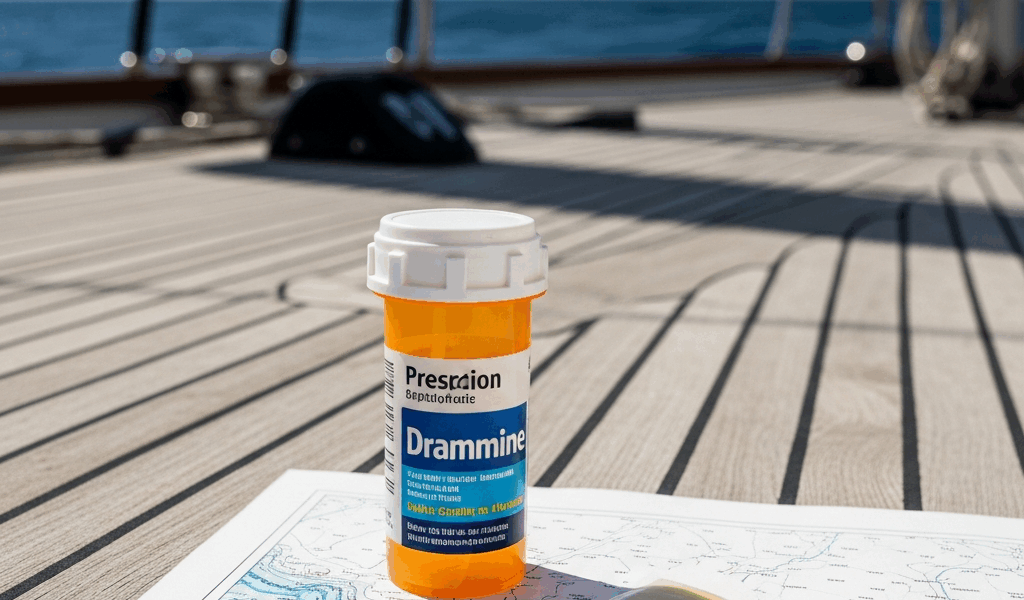
Dramamine (dimenhydrinate, 50mg tablets, available at every Walgreens for about $8 a box) works as an antihistamine that suppresses the signals between your inner ear and your brain’s vomiting center. It works. But it wears off every four to six hours, which means you’re redosing around the clock on a multi-day passage. And the drowsiness is significant — this is the stuff people take to sleep on long flights. On a boat where you need alert crew standing watches, that’s a genuine safety issue, not just a comfort concern.
For a day sail — say, a Saturday afternoon run down the coast, four to six hours on the water — Dramamine is a completely reasonable choice. One 50mg tablet about an hour before departure. Maybe a second dose mid-afternoon if the chop picks up. Total cost: less than a dollar. No prescription required, no planning required, grab it at the marina store.
Meclizine — The Middle Ground
Meclizine (sold as Bonine, or the generic version, about $10 for a 16-tablet pack) is also an antihistamine but with a longer action window — roughly 24 hours per dose — and noticeably less sedation than Dramamine. A lot of coastal cruisers land here. It won’t knock you out, it’s OTC, and once-daily dosing is manageable. The downside is it’s still not as reliable as the patch for heavy offshore conditions. I’ve talked to sailors who swear by Bonine for anything up to two or three days out; beyond that, most of them switch to scopolamine.
Why Sailing Is Different from Cruising
Probably should have opened with this section, honestly, because this is where a lot of generic seasickness advice falls completely flat.
When you read about seasickness remedies on a pharmacy website or a travel blog, the context is almost always a cruise ship or a ferry crossing. Those situations involve a few hours of mild motion, a relatively stable platform, and the ability to go lie down in a proper cabin. Sailing offshore is a different category of experience entirely.
Watch Schedules Change Everything
On a passage, you’re standing watches. Typically three on, three off, or four on, four off — your exact schedule depends on crew size, but the point is you’re expected to be alert, make navigation decisions, and handle sail trim at irregular hours of the night. A medication that makes you drowsy isn’t just uncomfortable. It’s a safety liability. A groggy helmsman in 20 knots of breeze at 0300 is a problem. This is why the sedation profile of whatever you’re taking matters so much more offshore than it does on a cruise ship where someone else is driving.
Multi-Day Exposure and Cumulative Fatigue
Seasickness often gets worse before it gets better. Most sailors find that days two and three of a passage are harder than day one — you’re sleep-deprived, your body is still adjusting to the motion, and you’re eating less than usual. Having continuous, reliable coverage from a 72-hour patch during that window is worth more than the convenience of OTC pills. The patch doesn’t require you to remember to take a dose during your off-watch sleep period. It just keeps working.
Heat, Sun, and Patch Adhesion
This one caught me off guard on a passage from the Chesapeake to the Bahamas. Tropical heat and sweating will degrade patch adhesion. I lost a patch somewhere around Cape Hatteras — peeled off while I was sleeping, probably from sweat. Some sailors use a small piece of medical tape (3M Transpore tape works well) over the edges of the patch to keep it anchored. Apply it to clean, dry skin behind the ear before you’ve been sweating. Hairline placement matters — too far into the hair and it won’t stick properly.
No Pharmacy Mid-Ocean
You cannot resupply 200 miles offshore. Whatever you leave the dock with is what you have. This is a mundane point but an important one. If you planned for a five-day passage and brought three days of Dramamine, you’re going to have a rough couple of days. Offshore sailors stock medications like they stock food — for the passage plus a buffer. Two extra patches. An extra box of Bonine as backup. A full bottle of ginger capsules (500mg, Nature’s Bounty or equivalent) in the nav station.
What Experienced Offshore Sailors Actually Use
Humbled by that Bermuda delivery experience, I started paying attention to what the serious offshore sailors in my fleet were actually doing. The answer is usually layered.
The Stacking Strategy
A lot of offshore veterans use the scopolamine patch as their primary tool and add ginger as a supplement rather than a replacement. Ginger capsules — 500mg to 1000mg, taken two to three times daily — have better clinical support than most people expect. They don’t work alone in heavy conditions for most people, but they seem to extend and reinforce whatever else you’re taking. Some sailors add a half-dose of meclizine (half a Bonine tablet, roughly 12.5mg) on the first night when conditions are roughest, then rely solely on the patch after that.
Tormented by nausea on her first bluewater passage, a friend of mine who now races offshore regularly told me she started using this combination — patch plus ginger plus a half dose of meclizine on day one — and hasn’t had a serious problem since. Her words: “I stop thinking about it, which means it’s working.”
Timing — Apply Before You Need It
This is the most common mistake first-time patch users make. The scopolamine patch takes four to six hours to reach effective blood levels. Apply it the evening before you depart, not on the dock the morning of your passage. Dramamine takes about 30–60 minutes to kick in. Meclizine is similar. None of these medications work well as a reactive treatment once you’re already seasick — they all function best as prevention.
What to Avoid
Alcohol. Full stop. Combining any of these medications with alcohol amplifies sedation and dramatically worsens nausea. One beer at the dock before a passage has ruined more first nights offshore than any weather system I can name. Eat before you go — a real meal, not just crackers. Empty stomachs are more prone to seasickness, not less, despite what some people believe.
The Verdict — Patch vs Pills for Your Trip
Here’s how I actually think about this now, after enough passages to have a strong opinion.
Day Sail — Four to Eight Hours
Dramamine 50mg or Bonine 25mg, taken 30–60 minutes before departure. Bonine if you’re at all sensitive to drowsiness or if you’re driving to the marina. Dramamine if you’ve used it before and know how your body responds. Don’t overthink it. A $10 box of Bonine handles the vast majority of day-sail situations cleanly.
Coastal Cruise — One to Three Days
Meclizine (Bonine) is the right call here for most people. Once-daily dosing, manageable side effects, OTC availability. If you know you’re a particularly bad sufferer, or if you’re heading into a forecast that promises 15-plus knots and steep chop, step up to the patch. Better to have it and not need the extra coverage than the reverse.
Offshore Passage — Three Days or More
Get the prescription. Apply the patch the evening before departure. Bring ginger capsules as a supplement. Keep a box of Bonine in the nav station as a backup. Tape the edges of your patch in tropical conditions. Start before you’re sick, not after.
The patch is not perfect — the dry mouth is annoying, the prescription requirement is a hassle, and losing one in the tropics is a real operational problem. But for multi-day offshore work, it’s the most effective tool available without a doctor on board. Dramamine is a fine medication. It’s just not built for the rhythm of standing watches across multiple days at sea, and no amount of convenience offsets that limitation when you’re 300 miles from the nearest land.
Stock the right medication for the right trip. That’s the whole answer.




Stay in the loop
Get the latest sail the seas mag updates delivered to your inbox.