Weather Helm Explained — Why Your Sailboat Pulls to Windward and How to Fix It
Weather helm has gotten complicated with all the conflicting advice flying around — reef early, don’t reef yet, ease the main, tighten the backstay, move the crew. If you’re coming off a two-hour watch with a wrecked shoulder, watching your autopilot hunt back and forth burning through your battery bank, or just constantly fighting the wheel — this is the guide you actually need. Not the naval architecture lecture. The one where we fix things.
What Weather Helm Actually Is — And Why Some Is Good
But what is weather helm? In essence, it’s your boat’s tendency to turn toward the wind when you let go of the tiller or wheel. But it’s much more than that — understanding why it happens is what separates sailors who manage it from sailors who just suffer through it.
Every sailboat has two invisible points worth knowing. The first is the center of effort — the combined point where your sail area is effectively pushing. The second is the center of lateral resistance — somewhere around the keel, where the hull resists sliding sideways. When the center of effort sits aft of the center of lateral resistance, the bow pivots toward the wind. Weather helm. When it sits forward, the bow falls away from the wind — that’s lee helm, and we’ll get to why that distinction really matters.
Here’s what most newer sailors don’t hear often enough: a small amount of weather helm is intentional. Designers build it in on purpose. Somewhere around 3 to 5 degrees of rudder angle to hold a straight course is considered healthy — it feeds tactile information through the helm, tells you the boat is loaded and driving, and creates a built-in safety response. Ease the tiller in a gust and the boat heads up, spilling wind and depowering itself. That’s the boat looking out for you. A well-balanced boat with slight weather helm is a forgiving boat.
I learned this on a friend’s Jeanneau Sun Fast 3300 — beautiful thing, light and responsive with just a whisper of pressure in the helm at 12 knots. I mistakenly thought more pressure upwind would be better and let the main out too far. Suddenly she felt dead. Zero feedback. That’s when I understood that no helm pressure isn’t the goal either. There’s a sweet spot, and it’s worth chasing.
When Weather Helm Becomes a Problem
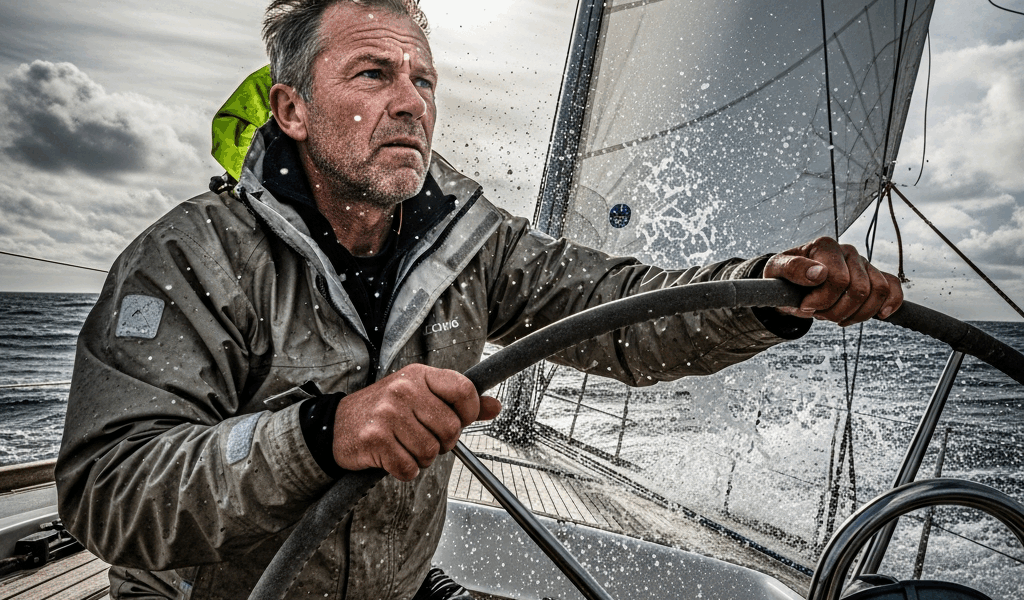
Excessive weather helm is a different animal entirely. We’re not talking about that pleasant 3-5 degree nudge — we’re talking about holding 10, 15, even 20 degrees of rudder just to go straight. That’s not sailing. That’s arm-wrestling a boat that doesn’t want to cooperate.
The symptoms are pretty obvious once you know what you’re looking for:
- Your forearm and shoulder are wrecked after a two-hour watch
- The boat constantly tries to round up — especially in gusts
- Your autopilot is hunting constantly, burning through battery, and still can’t hold a clean course
- Speed drops — a deflected rudder drags through the water like a brake
- You’re hiking out hard and still heeling past 25-30 degrees in moderate breeze
That last point matters more than people realize. Heel angle and weather helm are directly linked — more heel means worse helm, worse helm means you fight it harder, fighting it exhausts you, and meanwhile the boat heels further. A feedback loop that compounds fast. Breaking that cycle means understanding what’s actually causing it, not just muscling through it.
On longer passages this stuff really stacks up. Sailing from the Chesapeake to Bermuda with chronic weather helm means your crew rotates off watch more fatigued, your autopilot runs warmer than it should, and you arrive more worn out than necessary. Fix the helm problem at the dock. Not mid-ocean.
Five Causes of Excessive Weather Helm and Their Fixes
1 — Mainsail Trim
This is the first place to look. Almost always. The mainsail has more influence over helm balance than most sailors expect — it sits aft of center and contributes heavily to where the center of effort lands.
Ease the mainsheet. Seriously, just ease it two or three inches and see what happens. If you’re sailing upwind with the boom centerlined and the leech loaded hard, you’re pushing the stern away and driving the bow into the wind. Flattening the sail helps too — cunningham and outhaul depowering the lower sections. On most production boats, pulling the outhaul to maximum tension reduces draft and shifts power forward, easing helm noticeably. Traveler work is your friend here: dropping the traveler to leeward spills power from the main without blowing the leech open.
Frustrated by excessive helm during a daysail last summer, I grabbed a Windex angle gauge and confirmed I was holding 12 degrees of rudder. Eased the mainsheet two inches and dropped the traveler about 8 inches to leeward — helm dropped to roughly 4 degrees. That quick, that simple. Don’t make my mistake of assuming it must be something complicated.
2 — Mast Rake
Mast rake is often overlooked and it’s genuinely a tuning lever worth understanding. A mast raked aft moves the center of effort aft — more weather helm. A mast raked forward does the opposite. Most production cruising boats leave the factory with slight aft rake because mild weather helm is desirable — but if yours was tuned by a previous owner with different ideas, or the cap shrouds have stretched unevenly over several seasons, the rake might be further aft than you realize.
Check it with a plumb bob hung from the main halyard and note where it falls relative to a fixed point at the mast base. If you’re chasing a helm problem and nothing obvious is working, adjusting backstay tension or cap shroud lengths to bring the mast slightly more upright — done with a rigger, not guessed at — is worth doing.
3 — Excessive Heel Angle
Get the boat flatter. That’s the fix. Everything else follows from that.
Past 20-25 degrees of heel, the underwater hull shape changes dramatically — leeward sections dig in, the center of lateral resistance shifts, and weather helm climbs fast. Reefing reduces heel. Moving crew weight to windward reduces heel. Easing the main reduces heel. Pick your method based on what conditions are doing, but treat excessive heel as a helm problem first, not just a comfort problem.
4 — Rudder and Hull Issues
Less common, but worth ruling out. A bent or damaged rudder creates asymmetric drag. Growth on the hull — even light slime — affects flow around the keel and rudder. I’ve sailed boats that developed weather helm mysteriously over a season, hauled them out, and found bottom paint had failed in patches with uneven growth port to starboard. Apparently that’s enough to throw balance off measurably.
Check that your rudder is actually centered when the helm feels neutral. Wheel steering systems develop cable stretch and quadrant misalignment — a rudder that’s physically off-center when the wheel is “straight” will fight you all day and you’ll never find the cause staring at the sails.
5 — Boat Loading
Weight aft equals weather helm. Full stop. Loading gear, water, and provisions into the aft lazarette is the easiest way to quietly ruin your helm balance over a season. A cruising boat heavy in the stern trims with the bow rising and the stern squatting — that pushes the center of lateral resistance forward and tips everything toward weather helm.
Redistribute weight forward when possible. Water tanks that fill forward first help. Move anchors, chain, and heavy gear away from the transom — we’re talking a 100-foot anchor chain stuffed in the aft locker, a spare outboard, three cases of canned food. Mundane stuff. But on a loaded cruiser it can account for 5-8 degrees of helm just from loading habits. Worth rethinking the packing strategy before you rethink the rig.
Weather Helm vs Lee Helm — Which Is Worse
Probably should have opened with this section, honestly, because it reframes everything that came before it.
Lee helm means the boat wants to turn away from the wind. Release the tiller and the bow falls off to leeward. Sounds harmless — maybe even relaxing. It’s not. In a gust, a boat with lee helm bears away, further from the wind, potentially into a leeward broach with the sails fully loaded and the boat overpowered on an increasingly broad angle. There’s no automatic depowering response. You fight actively to keep control, and if you’re tired or distracted, you lose that fight fast.
Weather helm, by contrast, heads the boat up in a gust — spilling wind, depowering automatically. Yes, rounding up aggressively can be alarming, and in extreme cases leads to a windward broach — but the boat is trying to depower, not load up further. That’s what makes slight weather helm endearing to us sailors who’ve been out in conditions that got out of hand.
Lee helm is genuinely dangerous. Weather helm is manageable. That’s why designers default to slight weather helm. If you ever make changes to your rig or ballast and your helm goes light and crosses over to lee helm, stop and reverse course. Seriously.
Tuning for Different Conditions
Light Air — Under 10 Knots
Light air almost never produces weather helm problems on its own. The boat isn’t heeling, the sails aren’t loaded, things are generally fine. If you’re getting weather helm in 8 knots of breeze with full sail up, look at mast rake and weight distribution first — those are the culprits in flat conditions when sail forces aren’t doing much of anything.
Medium Air — 10 to 20 Knots
This is where trim work does most of the heavy lifting. Use the full range of your controls — traveler, sheet tension, cunningham, outhaul — before you reach for the reef. Keep the boat at 15-20 degrees of heel and work the main trim actively in gusts. Ease and trim. Don’t cleat it off and wander below for a snack.
Heavy Air — Above 20 Knots
Reef. Not “consider reefing.” Reef.
Here’s the sequencing that works on most masthead sloops: reef the main before you reduce the headsail. The main sits aft, it drives weather helm, and reducing it first helps balance. Many sailors do it backward — rolling up 30% of the furling headsail because it’s easy from the cockpit — then wonder why the boat still feels heavy on the helm with a full main and a small jib. That combination creates genuinely terrible balance. Reef the main to the first reef point, keep a fuller headsail, and you’ll typically sail faster with a noticeably lighter helm.
On a Beneteau Oceanis 46 or a Hunter 45 — boats with large, powerful mains — this sequencing makes a dramatic difference. A slab reef taking 60-80 square feet out of the main drops the center of effort both forward and lower at the same time. Helm improves. Speed sometimes improves too, because you’re no longer dragging a deflected rudder through the water at 12 degrees.
In sustained 25-plus knots, don’t be shy about a second reef. Sailing conservatively with a balanced helm is faster and safer than hammering upwind overpowered with the autopilot screaming and the crew hanging on for dear life. Get the boat balanced, let it find its groove — it’ll take care of you from there.
Weather helm is ultimately feedback. That pressure in the tiller or wheel is the boat talking. Learn to read it and you’ll understand what’s happening under you in a way that GPS and instruments never quite give you. Worth listening to.


Stay in the loop
Get the latest sail the seas mag updates delivered to your inbox.