
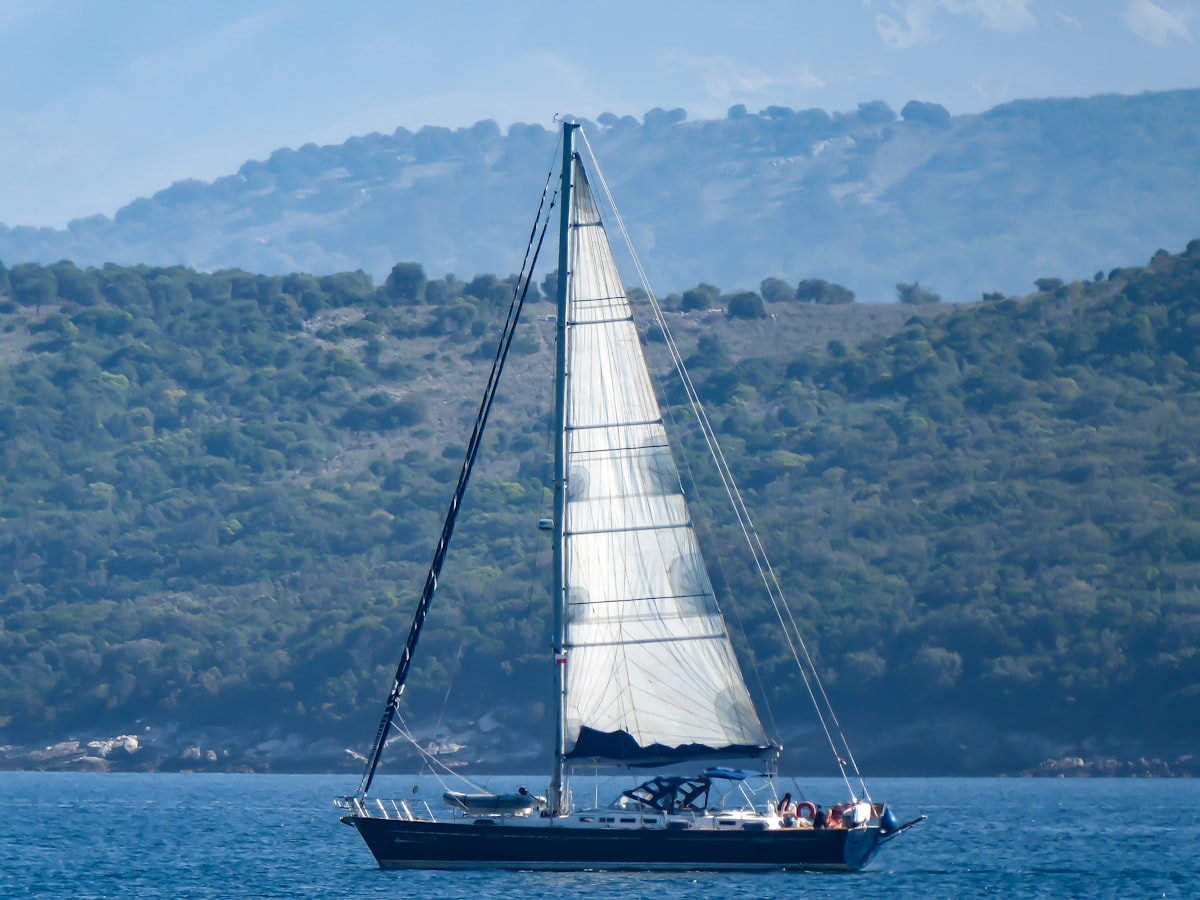
The Amel 50 is a 16.50 m (54 ft 2 in) overall, three-cabin center-cockpit cruising yacht designed for a small crew that values protection, centralized sail handling, systems access, and long-range living space. Its defining features are a deep cockpit under a hardtop, electric furling, twin rudders, an engine room accessed from the cockpit, a large aft owner’s cabin, and substantial tankage.
It is not a stripped-out performance boat, and it is not maintenance-free. At an official unloaded weight of 20.75 tonnes before options, the Amel 50 is a systems-rich luxury cruiser whose appeal depends on how much an owner values sheltered operation and an integrated cruising package. This review separates published specifications from buyer judgment and also distinguishes the original Amel 50 from the new Amel 50.2 announced in 2026.
Amel 50 specifications
| Specification | Amel 50 | What it means for an owner |
|---|---|---|
| Hull length | 15.50 m / 50 ft 10 in | The model name follows hull length more closely than overall length |
| Length overall | 16.50 m / 54 ft 2 in | Use LOA, bowsprit, and platform details when checking berth limits |
| Beam | 4.79 m / 15 ft 9 in | Creates interior volume but matters for slips and travel lifts |
| Draft | 2.15 m / 7 ft 1 in | Capable cruising draft, but restrictive in some shallow areas |
| Air draft | 23.30 m / 76 ft 5 in | Must be checked carefully for fixed bridges and overhead clearance |
| Unloaded weight | 20.75 t / about 45,746 lb, without options | Expect a substantial, comfort-oriented platform rather than a light-displacement racer |
| Average maximum loaded displacement | 24 t / about 52,911 lb | Payload planning still matters for stores, spares, equipment, and tender |
| Ballast | 5.36 t / about 11,817 lb | One part of stability; it is not a complete stability measure by itself |
| Diesel engine | 150 hp | Verify the actual engine, hours, service records, propeller, and controls on the specific boat |
| Fuel | 650 L / about 172 US gal | Useful tankage, but motoring range depends on real consumption and reserve |
| Fresh water | 600 L / about 159 US gal | Good capacity; a watermaker is equipment to verify, not assume |
| Mainsail | 63.5 m² / about 683 sq ft | Electric furling is central to the small-crew concept |
| Genoa | 57.5 m² / about 619 sq ft | Also on an electric furler in the brochure configuration |
| Staysail | 23.5 m² / about 253 sq ft | Listed as optional, so confirm it on the boat being considered |
These figures come from Amel’s 2025 brochure and can change with options or production updates. The brochure itself is noncontractual and warns that pictured equipment may be optional. A buyer should use the build sheet, equipment inventory, hull number, and survey for the specific yacht.
What makes the Amel 50 different?
The Amel concept is less about one headline performance number than about operating a large cruising boat with a small crew. The helm and sail controls are concentrated in a deep central cockpit beneath a hardtop with a sliding roof. The brochure specifies an aluminum mast with electric sail furling, an electrically furled genoa, and an optional electric staysail.
This arrangement reduces the number of routine sail-handling trips forward, but “push-button sailing” should not be confused with eliminating seamanship. Electric furlers, powered winches, charging systems, switches, relays, and controls need inspection, backup procedures, and preventive maintenance. Before buying, practice reefing, furling, anchoring, and steering with the exact installed systems—including their manual or emergency modes.
Cockpit, deck, and maneuvering
The center cockpit is one of the boat’s strongest cruising features. Its depth and rigid shelter protect the helm and create a secure social area, while the surrounding stainless-steel deck rail and multiple handholds support movement offshore. The cockpit position also separates the aft owner’s cabin from the saloon and forward cabins below.
Amel lists a hydraulic bathing platform with an integrated ladder, a large aft locker, and compensated twin rudders below that locker. Retractable bow and stern thrusters are described as options, not universal standard equipment. Those thrusters can simplify close-quarters handling, but buyers should inspect deployment, seals, motors, controls, batteries, and service history.
The 4.79 m beam and 16.50 m overall length deserve practical marina research. Confirm berth dimensions, local surcharges, haul-out capacity, and whether the yard can safely support the hull and access its systems.
Interior layout and life aboard
The Amel 50 has a three-cabin layout. The aft owner’s cabin includes a central double bed, seating or desk space, and a private bathroom. Forward is another double cabin with a central bed, plus a starboard cabin with bunk beds. The saloon sits near a longitudinal, fully equipped galley.
That arrangement works well for an owner couple who wants privacy aft while accommodating family, guests, or storage forward. It may be less attractive to buyers who prefer multiple equal guest cabins, several large heads, or charter-style capacity. Inspect lee-cloth arrangements, handholds, ventilation, mattress access, noise, and usable storage while imagining the boat underway—not only at a boat show.
Amel offered light oak or American walnut interiors in the cited brochure. Finish preference matters, but condition matters more on a used boat: look for leaks, damaged veneer, odors, condensation, loose joinery, corroded hardware, and evidence of poorly routed aftermarket installations.
Engine room and systems access
A particularly practical feature is the spacious insulated engine room accessed from the cockpit. Separating machinery from living areas can improve service access and help contain heat, noise, and odors. It also concentrates systems in a way that rewards organized maintenance.
During a survey, do not stop at engine hours. Inspect cold start, exhaust, mounts, shaft or drive arrangement, controls, charging, fuel tanks, filters, plumbing, seacocks, pumps, batteries, ventilation, fire protection, and evidence of saltwater or coolant leaks. Request oil analysis when appropriate and verify maintenance against manufacturer intervals.
The same caution applies to optional cruising equipment. A generator, watermaker, air conditioning, solar array, lithium bank, satellite terminal, or upgraded navigation package may be present, but none should be assumed from the model name. Record model numbers, installation dates, hours, output, spares, manuals, and service support.
Sailing performance: what can be said responsibly
The Amel 50 is a Berret-Racoupeau-designed sloop with a 14.50 m waterline, twin rudders, 63.5 m² mainsail, and 57.5 m² genoa in the official specification. Those facts suggest the intended balance: manageable sail handling and ocean comfort with more modern sailing characteristics than earlier Amel ketches.
They do not justify promising a universal speed. Passage performance depends on wind, sea state, sail inventory and condition, trim, loading, fouling, and crew decisions. A serious buyer should complete a sea trial that includes light-air sailing, reefing, tacking, reaching, motoring, reversing, autopilot operation, and close-quarters maneuvering.
Amel records that the model won European Yacht of the Year in the Luxury Cruiser category in 2018 and SAIL’s Best Boat 2020 award for monohull cruising boats from 41 to 50 feet. Awards are useful evidence of industry reception, but they do not replace a survey or prove that a particular used yacht is suitable.
Safety and offshore design details
The brochure identifies isolated compartments, flood-delay bulkheads, clear deck areas, the protected cockpit, and a stainless-steel rail around the deck. These are meaningful design choices for offshore use. Buyers should still verify the condition and operation of every safety-related system on the individual boat.
Review liferaft location and service date, EPIRB registration and battery, jacklines and attachment points, bilge pumps and alarms, fire equipment, emergency steering, navigation lights, communications, storm sails, hatch seals, gas installation, and abandon-ship equipment. Compare the inventory with the vessel’s flag rules and intended route.
For electronics planning, our guide to marine navigation systems and boat GPS explains how to build redundancy without confusing a chartplotter with a complete navigation plan.
Amel 50 drawbacks and ownership tradeoffs
- Complexity: electric furling, hydraulic equipment, thrusters, charging, and optional hotel systems add service points.
- Weight and size: this is a substantial yacht with berth, haul-out, sail, rigging, and systems costs to match.
- Draft and air draft: 2.15 m below and 23.30 m above constrain some cruising grounds.
- Integrated concept: buyers who prefer simple manual systems or extensive owner modification may find the platform less appealing.
- Configuration variation: photos and listings may show optional equipment. The actual build sheet matters.
- New-model transition: the Amel 50.2 has now been announced, which may affect new-boat availability and how buyers compare the original model.
None of these points makes the boat a poor choice. They define the owner profile: someone prepared to maintain an integrated luxury cruising yacht and willing to pay for access to appropriate technicians, parts, dockage, and insurance.
Original Amel 50 versus Amel 50.2
Amel launched the original Amel 50 in 2017. In May 2026, the yard announced the Amel 50.2 as its evolution, with a public debut planned for the Cannes Yachting Festival in September 2026. The new model is not simply another trim level of the boat reviewed here.
The official 50.2 specification lists a longer and wider hull, an inverted bow, revised cockpit, 16.70 m overall length, 4.99 m beam, 2.20 m draft, 21.92 t light displacement, 670 L fuel, 600 L water, and a 150 hp engine. Buyers comparing listings should confirm whether “Amel 50” means an original 2017–2026-era boat or the new 50.2.
Amel 50 pre-purchase checklist
- Identify the boat: hull number, build year, ownership and registration history, VAT or import status, and accident or insurance claims.
- Get the exact inventory: standard equipment, factory options, later installations, manuals, spares, and software or chart licenses.
- Commission an independent survey: hull and deck moisture, structure, keel, rudders, steering, rig, chainplates, sails, machinery, electrical and plumbing systems.
- Haul the boat: inspect underwater fittings, seacocks, propeller or drive, anodes, rudders, bearings, hull coatings, and evidence of grounding.
- Exercise powered systems: furlers, winches, platform, thrusters, windlass, pumps, generator, charging, and emergency overrides.
- Review service records: engine, standing rigging, sails, batteries, electronics, sanitation, refrigeration, air conditioning, watermaker, and safety gear.
- Complete a meaningful sea trial: sail in more than one mode, reef, motor at load, test autopilot, reverse, and monitor temperatures, vibration, voltage, and leaks.
- Price the first refit: obtain written estimates for overdue rigging, sails, batteries, electronics, pumps, coatings, safety equipment, and cosmetic work.
Our bluewater sailboat guide covers the broader design questions, while the bluewater cruiser comparison helps place the Amel 50 alongside other long-distance concepts.
Verdict: who should buy an Amel 50?
The Amel 50 is best suited to a cruising couple or small crew seeking a protected center cockpit, electric sail handling, substantial tankage, separated machinery space, and a private aft owner’s cabin. It deserves consideration for extended Mediterranean, Atlantic, and bluewater cruising when the buyer is comfortable with the responsibility of a complex 50-foot yacht.
It is less suitable for a buyer whose main goals are minimum displacement, simple manual systems, shallow draft, race-oriented feedback, or low ownership overhead. The correct decision comes from the specific boat’s condition and configuration—not from the model’s reputation alone.
Frequently asked questions
How long is the Amel 50?
The official brochure lists a 15.50 m hull length and 16.50 m overall length. Use the overall configuration when checking berth or storage limits.
How many cabins does the Amel 50 have?
It has three: an aft owner’s cabin with a central double bed, a forward double cabin, and a forward starboard cabin with bunk beds.
Can a couple sail an Amel 50?
The protected cockpit and centralized electric sail handling are expressly aligned with small-crew operation. A couple still needs the skills, physical capability, redundancy, and maintenance plan to operate a heavy, systems-rich yacht safely.
Does every Amel 50 include a watermaker and solar panels?
No assumption should be made from the model name. The brochure shows photovoltaic panels as part of the cockpit hardtop concept, while equipment and options can vary. Verify the build sheet and test the installed systems.
Is the Amel 50 still the current model?
Amel announced the Amel 50.2 in May 2026 as an evolution of the original, with its world debut planned for September 2026. Listings and older reviews may still refer to the original Amel 50.
Official sources
- Amel 50 official brochure and specifications
- Amel model history and awards
- Amel sales, handover, and customer-support description
- Amel announcement of the Amel 50.2
- Amel 50.2 official specifications
Specifications checked August 2, 2026. This independent guide is not affiliated with Amel. Equipment changes by hull, year, region, and option package; verify every material fact on the specific yacht.



Stay in the loop
Get the latest sail the seas mag updates delivered to your inbox.