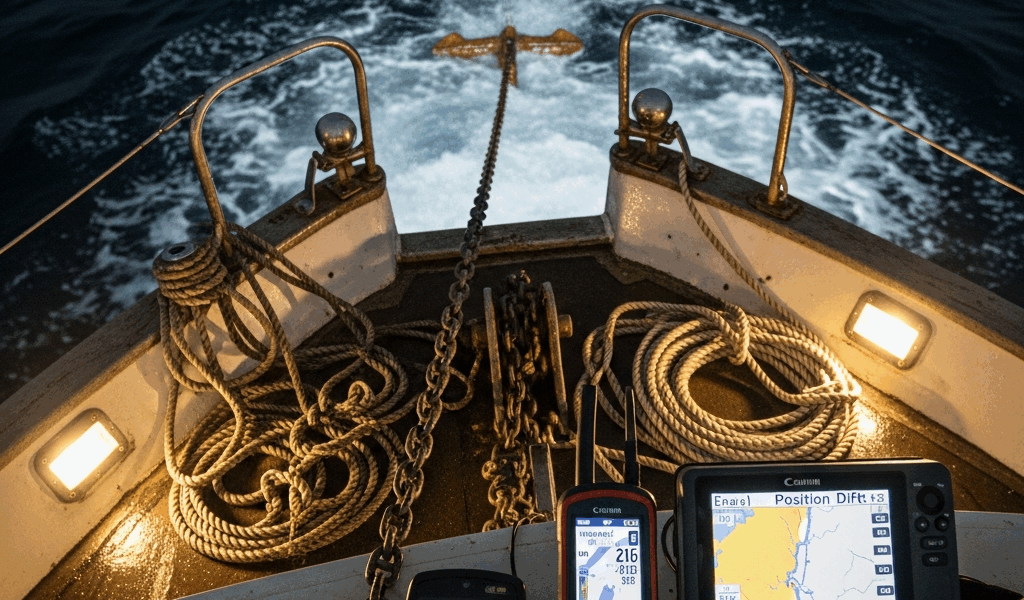
How to Tell Your Anchor Is Actually Dragging
Anchoring has gotten complicated with all the conflicting advice flying around. But at 2 a.m., when your eyes snap open and something feels wrong, you don’t need theory. You need to know exactly what’s happening — fast.
The boat is moving in a way it shouldn’t. Your stomach tightens. You think the anchor is dragging. Maybe it is. Maybe it isn’t. Most sailors I’ve talked to have chased a phantom drag at midnight, burned through adrenaline they needed, and found out it was just normal swinging. Don’t be that person. Confirm first.
Here’s how to tell the difference in the dark.
The GPS Alarm — Your First Check
For a permanent helm installation, confirm that the plotter, heading source, charts, and backup are designed as one system; see our marine navigation system guide.
If your chartplotter has an anchor alarm — and honestly, it should — that’s where you start. Apps like Anchor Pro and DragQueen work by drawing a perimeter around your GPS position at the exact moment you set the hook. Boat drifts outside that radius? Alarm triggers. Simple, reliable, not perfect, but close enough to trust at 2 a.m.
No alarm? Grab your handheld GPS or phone. Check your current position against what you plotted a couple hours ago. Moved 50 feet? Probably swinging. Moved 200 feet in a direction that doesn’t match the wind? Your anchor is dragging. That’s the number that matters.
The Bearing Triangulation Method
This is what I use when I don’t trust the electronics — which is often, honestly. Pick two fixed lights or landmarks on shore. A church steeple. A lighthouse. A red navigation buoy. Something that isn’t going anywhere.
From your cockpit, take a compass bearing to each one. Write them down — actually write them, don’t try to remember. Wait five minutes. Check again. Both bearings identical? You’re swinging safely on your rode. Both bearings shifted? You’re dragging.
I learned this off St. Augustine in 2019 after a GPS unit failed on me. Spent a full hour convinced I was dragging before a more experienced skipper came over in his dinghy and walked me through the two-bearing method. Humbling. But it worked immediately.
What Your Rode Tells You
Go forward to the bow. Put your hand on the anchor rode. Just feel it.
A boat swinging safely on a well-set anchor has a rode under constant, steady tension. Taut — almost rigid when there’s wind on it. A dragging anchor feels completely different. The rode goes slack, then snaps taut, then goes slack again as the boat slides sideways and the fluke loses its bite on the bottom.
That slack-snap-slack rhythm is your anchor dragging. That specific feeling is what triggers action. Don’t second-guess it.
The Visual Sweep
Look around. Are you the same distance from the same objects you were near when you anchored? Swinging means you’re moving in an arc — closer to something on one side, farther from something on the other. That’s normal. That’s fine.
Dragging means you’re moving in a line or drifting downwind. Your distance to every nearby object changes uniformly. The boat isn’t pivoting around the anchor. It’s being carried past it.
Once you’ve confirmed you’re actually dragging and not just nervous, you move to action.
The Most Common Reasons Anchors Drag at Night
Anchors don’t drag randomly. Something broke the contract between your fluke and the seafloor. Rank these by probability — diagnosing the cause is what determines your fix.
Insufficient Scope for Conditions
This is the culprit in maybe 60 percent of dragging incidents I’ve heard about. Probably more.
Scope is your rode length divided by water depth. A 2:1 scope is dangerously short under almost any conditions. You want 5:1 in calm water, 7:1 in moderate breeze, 10:1 in a gale. Those aren’t rough guidelines — they’re minimums.
Here’s what happens: the wind picked up tonight. Maybe gusted to 25 knots when the forecast said 15. Your 5:1 scope was fine at sunset. At 2 a.m., it’s not enough anymore. The load angle on your anchor increased. Holding power dropped — geometrically, not linearly. Your anchor walked.
The fix is immediate: let out more rode. If you have the water depth to do it, this solves the problem 90 percent of the time.
Poor Holding Bottom
You anchored in what looked like decent sand. Turns out it’s weed-choked mud over sand. Or kelp. Or rock with no real undercut. Or hard clay so dense your anchor skipped across it like a stone on water.
You can’t feel this until you’re dragging. The holding is binary — either the fluke dug in or it didn’t. No middle ground, no partial credit.
If you let out more scope and keep dragging, the bottom isn’t holding. You need to move to a better spot or deploy a second anchor. More scope won’t save you from bad bottom.
Anchor Not Set on Initial Drop
You anchored at sunset. Rode was set, boat settled, everything seemed fine. Except — and I’ve done this more than once — you never confirmed the anchor actually dug. You assumed.
A light fluke barely kissed the bottom. It held through a calm evening. Once the wind built past 15 knots, it broke free. You’re not dragging because something changed. You’re dragging because it was never properly set to begin with. Don’t make my mistake.
Wind Shift or Increasing Wind Speed
A weather system rolled through. Wind shifted 90 degrees and gusted to 30 knots. Your anchor was holding fine under the original load angle — but the new load pulls it sideways, at an angle the fluke simply can’t resist.
More rode helps here. So does motoring up to reset the anchor under the new wind direction. Either option works. Pick the faster one.
Chafe or Snubber Failure
Rarer, but devastating when it happens. Your nylon snubber — the line rigged between the rode and bow cleat to absorb shock and protect the windlass — has chafed through against a bow roller edge. The rode is now running directly over metal. Metal chafes nylon fast.
The rode frays. Eventually it breaks. At that point you’re not dragging — you’re drifting free because the connection to your anchor failed entirely.
Check the snubber immediately if you confirm you’re dragging. Feel it. Look for sawing marks or discoloration near the chafe point. If it’s compromised, re-rig before anything else.
Immediate Steps to Stop Dragging Right Now
Probably should have opened with this section, honestly. This is what keeps you off the rocks. You’ve confirmed the anchor is dragging — here’s what you do in the next ten minutes.
- Wake your crew. You need eyes and hands. A solo sailor can manage this, but barely, and not safely. Get everyone on deck now.
- Start the engine and put it in neutral. Don’t engage forward or reverse yet. Just have power ready. Check the exhaust. Confirm it’s running clean before you need it.
- Let out more rode if depth allows. Go forward. Release the anchor winch or rode cleat. Pay out 50 feet of chain or rode. Don’t drop the anchor — just add scope. Secure the rode when you’re done and wait.
- Wait two minutes. Still dragging? Check your GPS position and your two bearings again. If the dragging stops, you’ve fixed it. Go back to sleep.
- If you’re still dragging, motor slowly forward into the wind. Use idle speed — around 500 RPM if your gauge shows it. You’re not trying to move the boat significantly. You’re taking tension off the rode so the anchor’s fluke can right itself and reset on the bottom.
- Once you feel the rode go slack, stop the engine and reverse slowly into the wind. Gentle reverse power — just enough to set the anchor under load in its new position. Hold reverse for 10 full seconds. Boat moves backward? Anchor isn’t set. Boat holds position against reverse power? The anchor is dug in.
- Cut the engine, check position again, and confirm the dragging has stopped. Use the GPS alarm, the two-bearing method, and the rode-tension check together. All three confirm you’re holding? Go back to the cabin.
Theory doesn’t matter at 2 a.m. That sequence does.
When to Pull the Hook and Re-Anchor
Sometimes more scope and a reset aren’t enough. You need to move. Full stop.
Pull the hook if any of these apply:
- You have a lee shore — land sitting downwind — within 500 feet. If your anchor drags again, you’re on the beach. Period.
- Other boats are anchored immediately downwind of you. Dragging into someone else’s boat means a collision, possible injuries, and a liability conversation nobody wants to have.
- The bottom has confirmed itself as poor-holding — rock, heavy weed, hard clay. A reset won’t help when the seafloor physically can’t grip the fluke.
- You’re completely out of scope. Thirty feet of water, 300 feet of rode already out. More rode would put the anchor in impossible shallows or require motoring dangerously far downwind.
- You’ve reset the anchor three times and it keeps dragging. Something systemic is wrong — usually a mismatch between your boat’s windage, the anchor size, and the bottom type.
If you decide to move, wait until dawn when conditions allow it. Anchoring in the dark is exponentially more dangerous than anchoring in daylight — that’s not an exaggeration. Illuminate your work with deck lights and a flashlight. Choose deeper water for better catenary and holding. Look for a spot with real swinging room — at least 1.5 times your boat’s length in all directions. Confirm the bottom is clean sand or mud before you drop.
Once you’re settled in the new spot, execute a proper set: let out scope, feel the rode, motor forward into the wind, feel the slack, reverse into the wind, hold reverse for 10 seconds, confirm position with GPS. Only then do you close your eyes.
Gear and Habits That Prevent Anchor Dragging
Best cure is prevention. This section is short because you’re probably in crisis mode right now — but write these down for later.
Anchor Alarms
Use one. Anchor Pro runs about $50 on iOS and integrates cleanly with most chartplotters. DragQueen is around $30 and works on phones and tablets. I’m apparently an Anchor Pro person — it suits how I anchor — and DragQueen never quite clicked for me, though plenty of sailors swear by it. Set your alarm radius to 75 feet in benign anchorages, 150 feet anywhere sketchy. You’ll sleep better, and you’ll get warning before you’re actually in trouble.
Snubbers and Bridles
A nylon snubber — typically 3/8″ diameter, about 6 feet long, $25 to $40 at most chandleries — absorbs shock, protects your windlass, and adds crucial catenary to the whole system. Use one every single time you anchor. No exceptions.
Catamaran sailors should rig a bridle instead — a line from the anchor rode threaded through both bows and back to a central cleat. Distributes load, reduces swing radius. Around $30 in materials, maybe 20 minutes to rig the first time.
Chain Over All-Rope
All-rope rode is light and cheap. All-chain rode is heavier, and that weight creates catenary — the natural curve in your rode that absorbs energy and dramatically increases holding power. Budget allowing, run 200 feet of 5/16″ chain on a 35-footer. Runs roughly $1 per foot, sometimes a bit more. That weight buys real security. Can’t go all-chain? Compromise with 100 feet of chain followed by rope. Better than full rope every time.
Anchor Selection
Plow anchors — CQR-style — hold well in sand and mud but can roll out in grass or on rock. Modern roll-bar designs like the Rocna or Mantus, typically $200 to $400 depending on size, dig faster and hold in mixed bottoms. If you’re anchoring regularly across different conditions, a roll-bar anchor is worth every dollar.
That said — your anchor is only as good as the bottom it’s sitting in. No anchor holds reliably in heavy weed. No anchor holds in rock with no undercut to catch. Deploy the right tool for the bottom you actually have, and use your GPS alarm to catch problems before they become emergencies. That’s what makes proper anchoring endearing to us cruisers — it rewards preparation, every single time.


Stay in the loop
Get the latest sail the seas mag updates delivered to your inbox.