Why Your Autopilot Keeps Wandering Off Course
Sailboat autopilot troubleshooting has gotten complicated with all the conflicting advice flying around.
Here’s the short version: autopilot course-keeping failures fall into three buckets. Compass and calibration problems. Mechanical drive issues. Electrical faults in the control head or wiring. That order matters. A lot. Sailors who start with the motor and work backward waste entire afternoons — and real money — chasing symptoms that a 20-minute compass swing would have fixed. Start with the sensor. Move to the feedback unit. Then test the motor. This sequence lets you isolate almost any fault without calling a marina or even dropping anchor.
Step 1 — Check and Recalibrate the Compass
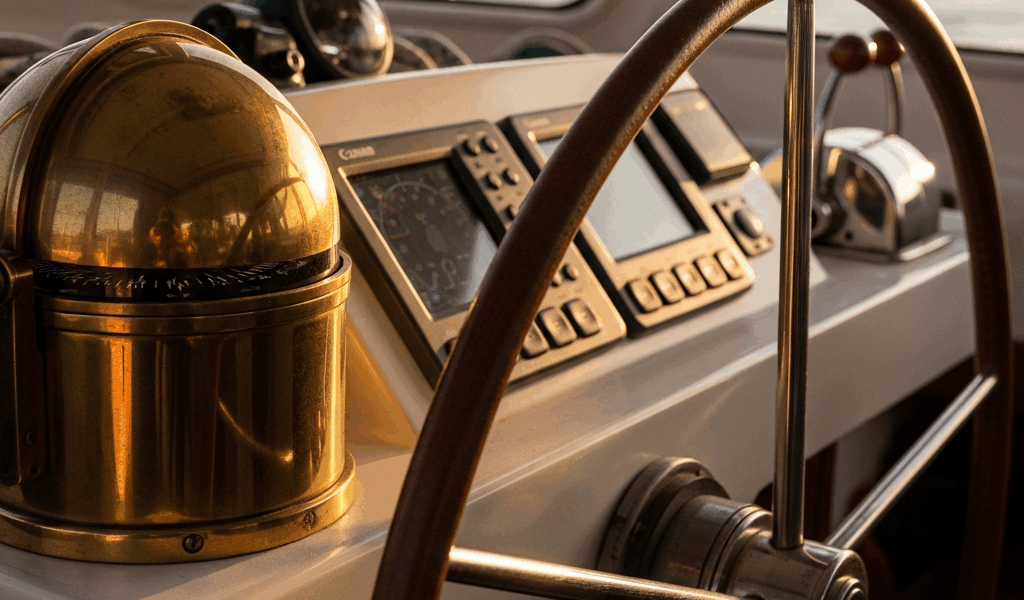
Most autopilot failures I’ve seen trace straight back to the fluxgate compass — the one sitting inside your pedestal housing or buried in the control head. It doesn’t fail dramatically. It drifts. New stainless fittings, a rewired instrument panel, a solar bracket installed six inches from the housing — all of it introduces magnetic deviation the autopilot’s processor never got updated to handle.
I upgraded a VHF antenna bracket on my boat once. Moved it maybe six inches closer to the compass. Spent two full days convinced my Raymarine ST60+ had died. It hadn’t. The compass swing just hadn’t been redone after the install. Don’t make my mistake.
Run your autopilot’s compass calibration routine first. Pull the manual for exact steps — they vary by manufacturer — but the basic process looks like this:
- Access the control head menu and locate “Compass Calibration” or “Compass Swing”
- Some systems want a figure-8 at slow speed; others need a full 360-degree circle
- The autopilot logs magnetic readings across multiple headings and builds a deviation table internally
- You’ll steer slowly, hold each heading roughly 10–20 seconds, then move to the next cardinal point
The whole thing takes 20 to 40 minutes depending on your boat and system. Do it on calm water. Stay away from fishing vessels running active radar, tugboats, and bridge girders — all of those will skew your results mid-swing.
A clean calibration shows error values under ±3 degrees across all headings. Readings jumping 10-plus degrees between adjacent points, or an error code like “Deviation Out of Range,” suggests the fluxgate element itself is failing. That’s a parts call. But honestly, most wandering-off-course problems disappear after one proper recalibration.
Before you even run the swing — physically inspect the area around the compass. Stainless fittings, wire bundles, a mounted phone holder someone added last season. Move anything conductive at least 12 inches away. I’ve watched sailors fix compass drift just by relocating a suction-cup GPS mount that had migrated three inches too close to the housing over a winter.
Step 2 — Inspect the Rudder Feedback Unit
But what is a rudder feedback unit? In essence, it’s the sensor that tells your autopilot where the rudder actually is at any given moment. But it’s much more than that — it’s the component that closes the steering loop entirely. Without accurate feedback, the system is steering blind.
Probably should have opened with this section, honestly. Too many sailors skip straight to the drive unit assuming the motor’s blown when the real problem is a $200 feedback sensor nobody thought to check.
Mounted at the base of the rudder post or along the quadrant, the RFU measures rudder angle through either a potentiometer — a variable resistor — or a solid-state sensor. When the autopilot commands the drive unit to move the rudder, the RFU reports back whether it actually moved. Bad data from a failing RFU causes the autopilot to overshoot, then overcorrect, then overshoot again — that maddening hunting behavior where the boat swings back and forth chasing a heading it never quite reaches. That’s what makes feedback failures so frustrating to diagnose. They look exactly like motor problems.
Here’s how to inspect it:
- Locate the RFU and trace its wiring back to the control head or drive unit
- Look for loose linkage arms, corroded connectors, or chafed wiring along the run
- If the linkage arm is loose, the RFU won’t track rudder position accurately — tighten the fasteners, then jiggle the arm gently by hand while someone watches the rudder angle display to confirm the reading matches physical movement
- For a resistance check, switch off power, disconnect the RFU connector, and set a multimeter to ohms. Manually move the rudder arm through its full range — resistance should change smoothly from minimum to maximum. A reading that sticks, jumps, or flatlines points to a dead potentiometer element
Typical resistance range for mechanical units runs 0 to 5 kΩ, though specs vary — confirm against your manual. No change in resistance as you move the arm means the potentiometer is done. Replacement time.
Corroded connections are worth trying first, though. Disconnect the plug, hit both sides with CRC QD Electronic Contact Cleaner — the 11-ounce can runs about $9 at West Marine — let it dry 10 minutes, reconnect. I’ve seen that one step restore a feedback signal that looked completely dead on the multimeter.
Step 3 — Test the Drive Unit and Clutch
The drive unit is the muscle. It grabs the rudder and moves it. Three main types show up on most sailboats: linear hydraulic rams, rotary vane motors running in oil, and electric tiller drives. Each one fails differently — at least if you know what to listen for.
Start by listening. A healthy drive unit is nearly silent or makes a faint whir during steering inputs. Grinding, squealing, or a cycling high-pitched whine that starts and stops in quick rhythm? Something’s wrong.
That cycling sound — motor starting, stopping, starting again — usually means the clutch is slipping. The drive unit gets a steering command, can’t grip the rudder hard enough to actually move it, revs harder, the autopilot sees no rudder movement and commands again, and the whole loop repeats. The boat wanders. The motor thrashes. Nothing useful happens.
Check fluid level first if you’re running a hydraulic ram. Lewmar and Simrad linear rams both have small reservoirs. Low hydraulic fluid produces exactly this symptom. Top off with the fluid your manual specifies — not all hydraulic oils are interchangeable, and mixing types causes foaming, which kills pressure. A quart runs $15 to $40 depending on brand.
For electric tiller drives — older Raymarine ST1000s, Furuno units — verify clutch engagement specifically. Most systems allow manual clutch disengagement from the control head for hand-steering. If the clutch won’t engage, the motor can spin indefinitely and the rudder won’t move a degree.
Run a drive-unit test from the control head. Navigate into “Service” or “Diagnostics” and find “Drive Test” or “Motor Test.” The system commands the motor to move the rudder a few degrees each direction while you watch and listen for smooth, deliberate movement. Hesitation, grinding, or zero response points to drive failure or clutch slip. If the motor won’t respond to test commands but worked before, you may have a wiring fault between the control head and drive unit — check every connector along that run for corrosion, bent pins, and loose contacts. Salt spray finds everything on a boat.
When to Bypass and Hand Steer Until Port
If you’ve worked through all three steps and the autopilot still won’t hold course, you’ve got a real decision in front of you. Some passages — singlehanded runs, heavy weather watches, exhausted crew — genuinely can’t continue safely without autopilot. Others can manage fine.
Be honest about which situation you’re actually in. Hand-steering 300 miles in a seaway grinds down focus fast and invites the kind of slow, compounding mistakes that create real danger. A watch rotation of two to four hours on helm with a second person monitoring compass and wind makes continuation manageable. If you carry a wind vane as backup — a Hydrovane or Monitor — engage it now. It won’t track as precisely as an electronic autopilot, but it holds course reliably when wind conditions stay stable. That’s what makes a vane endearing to bluewater sailors who know their electronics will eventually quit at the worst possible moment.
So, without further ado, here’s the practical part: if you’re offshore and stuck, document everything before you make port. Photograph the control head display. Write down every error code. Log the exact time the failure started and what conditions preceded it. Most marine electronics shops charge $75 to $150 per hour in labor — I’m apparently on the expensive end of that range and Defender Marine works for me while cheaper shops have never quite solved the same problems. A clear diagnostic trail means the technician spends their time fixing the actual fault rather than reconstructing your afternoon’s troubleshooting from scratch.
The systematic approach works because autopilot failures almost always cascade in order: compass drift first, then feedback problems, then motor failure. Skip steps and you’ll spend money replacing parts that weren’t broken. Take them in sequence, stay methodical, and you’ll isolate the fault — even offshore, even in the dark. That’s seamanship.



Stay in the loop
Get the latest sail the seas mag updates delivered to your inbox.