How Fast Should Zincs Actually Last
Sailboat zinc maintenance has gotten complicated with all the conflicting advice flying around at docks and on forums. Last spring, I watched a liveaboard pull his shaft zinc after just four weeks. Completely gone. The marina manager shrugged — “tropical water eats them faster,” he said. That answer stuck with me wrong.
Here’s the baseline most sailors never get told upfront: a quality shaft zinc in normal saltwater should survive six to twelve months. Warm tropical water? Maybe four to eight. Cold northern climates push twelve to eighteen months realistically. But four weeks? Two weeks? That’s not consumption. That’s a system failure wearing a zinc’s clothing.
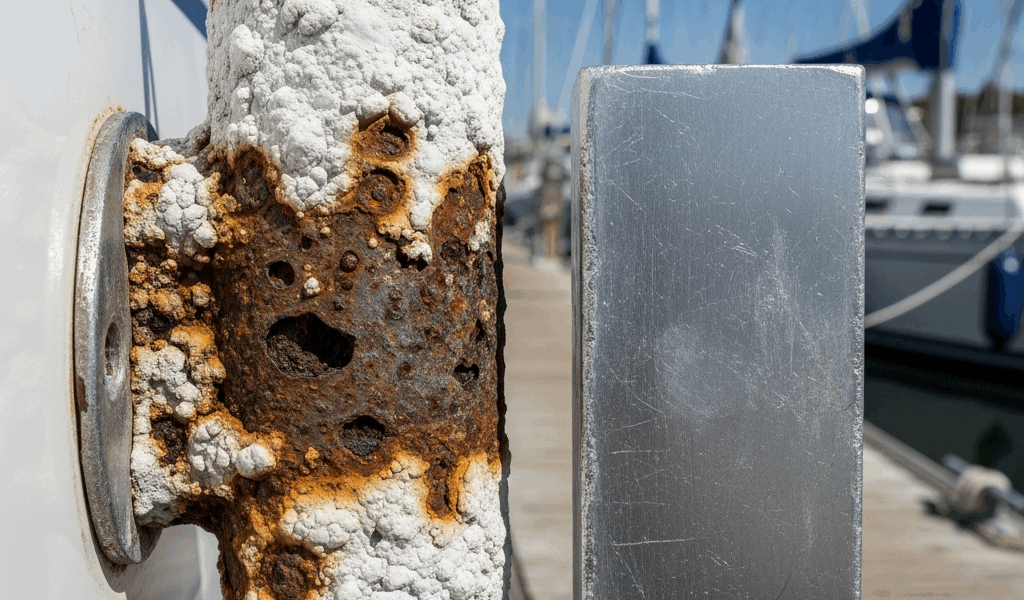
Learning to read “normal” is the whole game here. A properly functioning zinc recedes evenly — turning white and chalky as it does its job. Smooth, predictable wear. Abnormal consumption looks different: deep pitting, honeycomb corrosion, or a zinc that vanishes while neighbors sit untouched. Those aren’t the same thing at all.
Temperature matters, sure. A shaft zinc works harder in 85-degree water than 55-degree water. Surface area matters too — a fat zinc outlasts a thin one, obviously. But here’s what most sailors miss entirely: water chemistry and electrical cleanliness matter infinitely more than temperature or physical size.
If your zincs are burning through in weeks instead of months, your water isn’t the problem. Your boat’s electrical system is.
Check the Marina First — Stray Current Is the Culprit
Probably should have opened with this section, honestly. Stray current galvanic corrosion is the number one reason zincs fail prematurely — and most boat owners spend months replacing hardware and checking bonding systems while the real villain sits at the dock fifty feet away.
When a neighboring boat has faulty shore power wiring, AC current leaks into the water. That stray current turns your boat into a corrosion target. The zinc burns away fast — sometimes in days. It’s not protecting your propeller shaft anymore. It’s just dying while your shaft quietly suffers.
How do you confirm stray current is your problem? Get a zinc reference electrode. This costs about sixty dollars and takes thirty seconds to use. Drop it in the water near your hull, touch your multimeter probes to it and to your running light, and read the voltage. Anything above 100 millivolts indicates stray current. Above 300 millivolts, your marina is genuinely unsafe for any through-hull metal.
Don’t have a reference electrode? Simpler test. Grab a stainless steel bolt and a copper pipe fitting. Leave them in the water overnight. White corrosion deposits by morning? That’s galvanic corrosion talking. That’s your marina telling on itself.
The fix is non-negotiable: install a galvanic isolator on your shore power cable. Newmar and Hubbell both make solid units — cost runs three hundred to five hundred dollars depending on amperage. This device blocks AC leakage while allowing normal power flow. Think of it as a pressure relief valve for bad electrical neighbors.
Some marinas install isolation transformers at the pedestal instead. That’s better if you can get your marina to pay for it. Either way, the shore power system needs fixing — not your zinc.
Diagnosing Your Specific Marina
Before spending money on a galvanic isolator, confirm the problem is actually at your marina. Moved boats recently? Zinc lasted normal time at the last marina and dies here? That’s your answer right there. The marina changed. Not your boat.
Talk to other owners on the dock — ask specifically about zinc consumption rates. Five boats reporting the same problem means stray current is definitely present. One boat with failing zincs might have a bonding system issue. Five boats? Marina electrical problem, full stop.
Inspect Your Bonding System for Open Circuits
Frustrated by rapid zinc consumption and a clean-looking boat, I replaced a shaft zinc last month and found the bonding wire had corroded completely at the engine block. Green crusty deposits covered the terminal. Still physically attached — electrically dead. No conductivity at all. That was a fun afternoon.
Your bonding system is a copper highway connecting every conductive metal on the boat. Engine block bonds to propeller shaft. Shaft bonds to through-hulls. Through-hulls bond to the zinc. Break that highway anywhere and isolated metal fittings start corroding on their own terms — one sacrificial zinc can’t protect hardware that’s electrically disconnected from it.
Here’s what to check:
- Trace the bonding wire from your engine block to your propeller shaft coupling. Look for white or green corrosion at the terminals.
- Check continuity with a multimeter set to ohms. Positive probe on the engine block, negative on the shaft. Reading should be close to zero ohms.
- Inspect the bonding wire at every through-hull — seacock fittings, transducers, keel bolts.
- Confirm the main bonding bus is actually connected to your zinc.
Corroded terminals are unmistakable. Green or white crusty deposits, sometimes spreading underneath the connection lug itself. You pull on the wire and it moves — but doesn’t conduct electricity. This happens especially on boats over ten years old or boats that live in warm water year-round.
The fix is straightforward. Disconnect the bonding wire at both ends. Sand the terminal lugs with 120-grit sandpaper until bright copper shows. Clean the mounting surface the same way. Reconnect with a lanolin-based corrosion inhibitor on the terminal — Lanacote works, Duralac works — and tighten the connection screw firmly. Retest continuity before buttoning anything up.
If the bonding wire itself is corroded, replace it. Marine-grade bonding wire is cheap — around ten dollars a foot at any chandlery. Use #8 or #6 gauge copper wire depending on your boat size. Don’t make my mistake of nursing a marginal wire along for another season.
Wrong Zinc for Your Water Type or Metal
But what is a sacrificial anode, really? In essence, it’s a chunk of metal that corrodes so your boat doesn’t have to. But it’s much more than that — the specific chemistry matters enormously depending on your water and your hardware.
Three types exist: zinc, aluminum, and magnesium. You probably need exactly one. Using the wrong type means either wasting money on anodes that underperform or installing hardware that protects nothing at all.
Pure zinc alloy performs best in typical saltwater — temperatures between 50 and 80 degrees, standard salinity. Most cruising boats run zinc. Martyr and Tecnoseal make quality versions. A typical shaft zinc weighs eight to twelve ounces and runs fifteen to forty dollars depending on size.
Aluminum anodes work better in warm tropical water and brackish environments. Aluminum corrodes faster than zinc in hot saltwater, sacrificing itself more aggressively — which is exactly what you want it to do. Caribbean year-round? Aluminum outperforms zinc. Tecnoseal and Martyr both make excellent aluminum shaft anodes. You’ll pay thirty to fifty dollars, but they last longer where it counts.
Magnesium anodes are for freshwater only. I’m apparently a magnet for watching people learn this lesson the hard way — a guy I know, new boat, California Delta cruising, installed magnesium zincs because they’d worked great on his old powerboat in freshwater. His propeller shaft started pitting after two weeks. He switched to zinc. Problem stopped. Wrong anode for the environment, entirely.
The metal composition of your propeller and shaft matters too. A Nibral propeller — nickel-bronze-aluminum alloy — behaves differently than stainless steel. Most sailors have no idea what their propeller is actually made of. Check your boat documentation or ask your surveyor. The correct zinc chemistry for your specific metallurgy makes a measurable difference.
How to Set Up a Zinc Inspection Schedule That Works
While you won’t need to pull your zincs weekly, you will need a handful of consistent habits to catch problems before they eat your hardware budget. Quarterly inspection is the minimum. Every sixty days is better. Every thirty days if you’re serious about it.
Here’s the practical routine: pull the zinc, look at it, write it down. Log the date, estimate what percentage remains. The rule is simple — replace your zinc when it’s 50 percent consumed. Don’t wait until it’s gone. Even a week of unprotected exposure causes measurable pitting on aluminum and brass fittings. That damage doesn’t reverse itself.
Keep a corrosion log. Nothing elaborate — a spreadsheet with dates and plain observations. “June 15: shaft zinc 90 percent intact, white chalky surface, no pitting visible.” “September 2: shaft zinc 40 percent, replace next week.” That history is how you catch anomalies. A zinc that lasted six months last year and three weeks this year means something environmental changed — your marina, your bonding system, or your anode type.
First, you should weigh the zinc when you install it — at least if you want actual data instead of guesswork. Use a kitchen scale. One minute. Weigh it again at each inspection. You’ll get real consumption rates in ounces per month. Track this over a year and you’ll see patterns: seasonal variations, tropical cruising impact, the difference between two marina slips. Real numbers beat gut feelings every time.
The honest takeaway: solving zinc problems isn’t about buying better hardware. It’s about understanding your boat’s electrical system, your marina’s electrical safety, and your specific cruising environment. Fix the corroded bonding terminals. Test for stray current. Use the right zinc chemistry. Inspect on a schedule. Most premature zinc failures solve themselves once you address the actual system problems underneath — and that’s what makes this whole subject so endlessly frustrating and fixable at the same time.




Stay in the loop
Get the latest sail the seas mag updates delivered to your inbox.