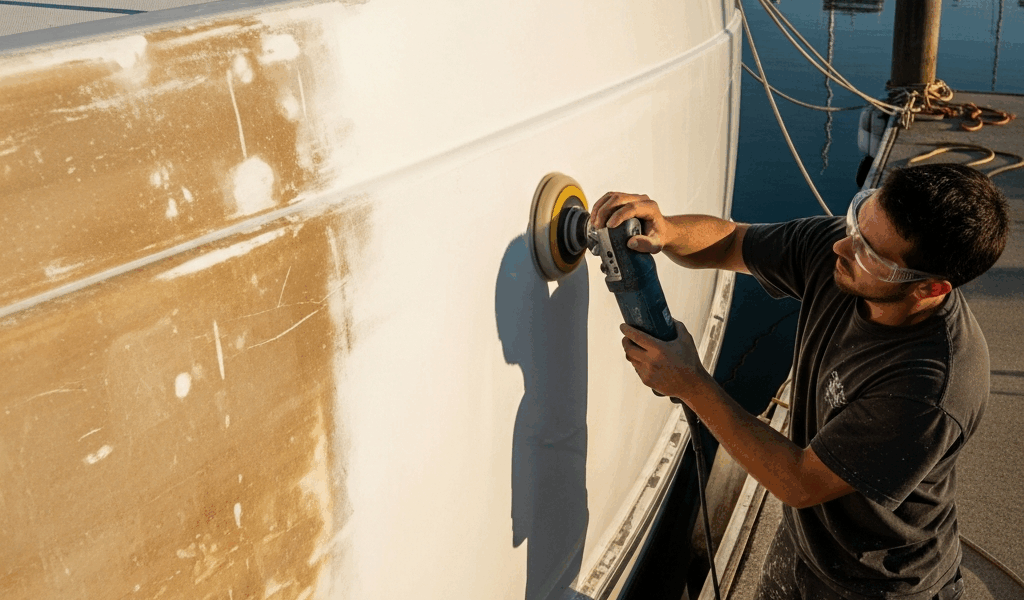
The best “cleaner” for an oxidized fiberglass boat depends on whether the surface is stained, lightly hazed, moderately chalky, or deeply degraded. Washing removes contamination. A cleaner-wax can address very light oxidation. Polish refines gloss. Compound removes more damaged gelcoat. Wax or sealant protects the corrected surface but does not remove oxidation by itself.
If the hull is still glossy but has dirt, rust streaks, or a brown waterline, begin with our fiberglass boat-cleaning guide. This page is specifically about restoring oxidized gelcoat above the waterline.
First determine whether it is dirt, stain, or oxidation
- Wash a small test area with fresh water and a labeled marine soap.
- Dry it completely and inspect in indirect light.
- Run a clean dark cloth or fingertip over the surface.
- If colored dirt transfers and the surface underneath is glossy, continue cleaning.
- If the clean surface remains hazy or leaves a chalk-like residue, it is oxidized.
Oxidation is degradation of the outer gelcoat surface from ultraviolet exposure and weathering. It cannot be rinsed away because the damaged layer itself must be refined or removed. Always test the least aggressive process first; gelcoat has finite thickness, and unnecessary compounding removes material that cannot be put back without refinishing.
Choose the process by oxidation severity
| Condition after washing | Starting process | Goal |
|---|---|---|
| Glossy with isolated stains | Surface-specific stain remover | Remove contamination without abrasion |
| Slight haze, no heavy chalk transfer | Cleaner-wax or fine polish | Clean/refine lightly and protect |
| Noticeable fading or chalk, shallow defects | Dedicated oxidation remover or medium compound, followed by polish/protection as directed | Remove degraded surface and restore clarity |
| Heavy chalking, deeper scratches, uneven prior repair | Professional assessment or a manufacturer-specified multi-step compound/polish system | Correct without cutting through thin gelcoat |
| Cracks, crazing, blisters, exposed glass, or very thin gelcoat | Repair/refinishing assessment | Fix the defect rather than disguising it |
Current products worth comparing
Product names do not replace the label. Confirm that the exact formula is approved for fiberglass gelcoat, read its current technical and safety information, and test it on your boat.
Light oxidation: fiberglass cleaner-wax
A cleaner-wax combines mild correction and protection in one step. It suits a surface that is clean but lightly hazed, not one shedding heavy chalk. 3M’s fiberglass cleaner-and-wax guidance describes its cleaner-wax for light-to-medium oxidation and recommends a more aggressive restorer when chalk transfers to a hand or dry rag.
The benefit is speed; the limitation is correction depth. If a test section stays cloudy after one proper application, do not keep grinding indefinitely with the same product. Reassess severity and gelcoat condition.
Moderate oxidation: Meguiar’s M4916
Meguiar’s Marine/RV Heavy Duty Oxidation Remover M4916 is formulated for moderate oxidation, water spots, stains, and scratches on fiberglass gelcoat. The manufacturer says it can be applied by hand or machine and uses diminishing abrasives. Follow its label for pad choice, work time, residue removal, and follow-up protection.
An oxidation remover is not automatically a one-step seasonal finish. After the test area, inspect in good light and determine whether the surface needs a refining polish and whether the selected product leaves adequate protection or requires a separate wax/sealant.
Heavier restoration: compound and polish system
A more aggressive marine gelcoat compound can restore heavily weathered surfaces, but the risk rises with cut. 3M Marine High Gloss Gelcoat Compound, for example, is a professional-oriented compound for gelcoat correction and contains no wax or silicone. That means it is a correction step, not final protection.
Heavy correction may require separate compounding, polishing, and protection stages. If gelcoat thickness is uncertain, edges or molded details are thin, or prior repairs are visible, a qualified marine detailer or repair shop is the safer choice.
How to restore oxidized gelcoat
- Inspect and repair first. Do not compound over cracks, crazing, blisters, exposed laminate, or failing paint.
- Wash and decontaminate. Remove salt, dirt, wax residue, and surface stains with compatible products. Correction pads must not grind contamination into the gelcoat.
- Move into shade and control temperature. Follow the product’s acceptable conditions and never let residue bake onto a hot panel.
- Mask vulnerable edges and materials. Protect graphics, rubber, unpainted plastic, textured nonskid, metal, seams, and adjacent coatings as required.
- Make a small test section. Start with the least aggressive pad/product combination likely to work.
- Follow machine and product instructions. Use compatible pads, speed, pressure, work area, and cleaning intervals. Generic internet settings are not a substitute for the tool and compound instructions.
- Inspect after residue removal. Look for uniform color and gloss, swirl marks, haze, heat, or evidence that the process is too aggressive.
- Refine if necessary. A cutting compound may leave haze that requires a separate polish.
- Protect the corrected finish. Apply the compatible wax, polymer sealant, or coating specified for the system.
Hand application or machine polishing?
Hand application provides control on small areas, edges, and fittings but becomes slow and inconsistent across a hull. A dual-action machine can improve consistency for many owners; a rotary can correct faster but also creates more risk of heat, holograms, and cutting through edges when used poorly.
Choose the method supported by the product manufacturer. Keep pads clean, use separate pads for different steps, and stop if the panel becomes unexpectedly hot or the finish changes unevenly. Large boats and severely oxidized surfaces are often cheaper to do once professionally than to repair after an aggressive first attempt.
Why acid hull cleaner does not fix oxidation
Acid-based hull cleaners can be effective on mineral, rust, tannin, or waterline stains when their labels approve the surface. They do not rebuild UV-degraded gelcoat. A stained hull may look dramatically brighter after an acid wash, but remaining chalk and haze still require the appropriate correction process.
Repeatedly applying stronger stain remover can strip protection, damage adjacent materials, increase exposure risk, and send unnecessary chemicals into runoff. Diagnose the clean, dry test area before escalating.
Protection and maintenance after restoration
A corrected surface needs protection from UV, salt, and contamination. Use a marine wax, sealant, or coating compatible with the correction system and apply it at the manufacturer’s interval. Our boat spray-wax guide covers quick maintenance products for a finish that is already restored; spray wax is not a substitute for removing established oxidation.
- Rinse salt and loose contamination promptly.
- Use a wash product that does not unnecessarily remove the chosen protection.
- Avoid dry wiping dusty gelcoat.
- Address stains before they require aggressive treatment.
- Reapply protection according to product condition and instructions, not an invented universal schedule.
- Use covers or shaded storage when practical to reduce UV exposure.
Safety and environmental precautions
Compounds, cleaners, solvents, and coatings have different hazards. Read the current label and safety data sheet, wear the specified eye, skin, and respiratory protection, provide ventilation, and keep ignition sources away when required. Do not mix products.
Capture liquid runoff, dried residue, used pads, and contaminated wipes according to marina and local rules. EPA guidance recommends minimizing the release of cleaners, solvents, paint, and hull-maintenance debris to surface water. A product described as biodegradable still should not be discharged automatically.
Bottom line
Wash first, diagnose the clean surface, and test the least aggressive correction method. Use cleaner-wax for light haze, a dedicated oxidation remover for moderate chalking, and a properly designed compound/polish system—or professional help—for heavy degradation. Finish with compatible protection and maintenance so the restored gelcoat does not immediately begin the same cycle again.




Stay in the loop
Get the latest sail the seas mag updates delivered to your inbox.