Sailboat Engine Overheating Has Gotten Complicated With All the Conflicting Advice Flying Around
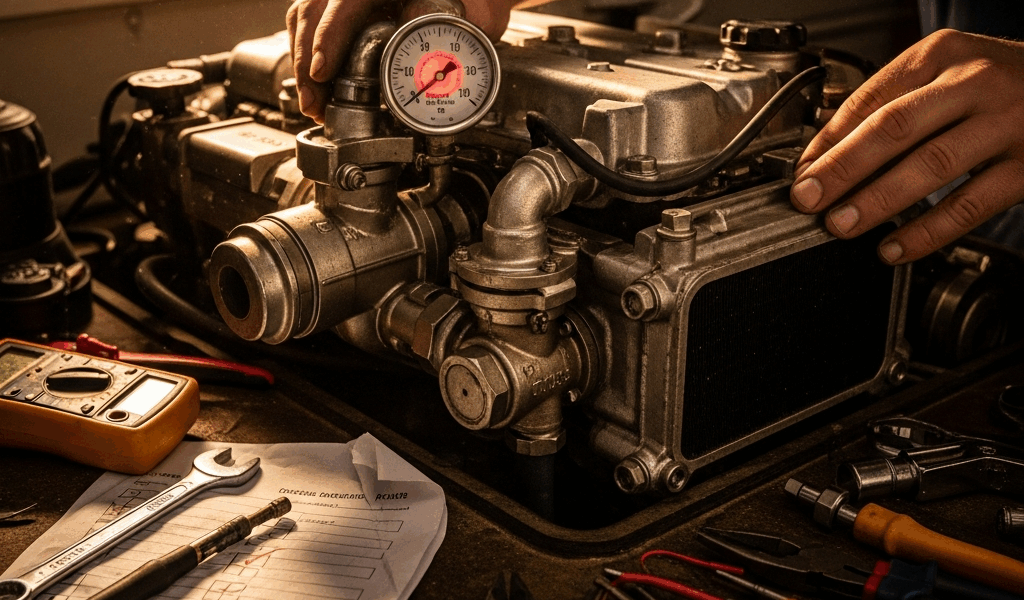
Here is the thing most guides skip: your engine runs two completely separate cooling loops. There is the raw water loop — seawater pulled in through the through-hull fitting — and the freshwater loop, which circulates glycol coolant around the block itself. Raw water cools the freshwater through a heat exchanger. Both loops have to work. One alarm, two completely different failure paths. That is what makes diagnosing this so frustrating for sailors who assume it is always the same culprit.
But what is an overheating event, really? In essence, it is your engine telling you heat transfer broke down somewhere. But it is much more than that — it is a decision tree, and every branch matters. By the end of this, you will know which branch you are on and what to do before you touch the throttle again.
Start Here — Check the Raw Water Side First
Open the engine compartment. Find the seacock — that through-hull fitting below the waterline. Is the lever running parallel to the intake hose, or sitting perpendicular to it? I once watched a crew spend forty minutes diagnosing a “catastrophic failure” that turned out to be a closed seacock from the last haul-out. Someone shut it, nobody wrote it down. That was embarrassing for everyone involved.
Seacock open? Good. Move to the raw water strainer — that bronze or plastic inline bowl between the through-hull and the engine. Unscrew the bottom drain plug. If black slime pours out, or you pull a wad of seaweed out of the basket, you have found your problem. Clean it thoroughly. This single step — honestly, the least glamorous fix imaginable — resolves roughly forty percent of the overheating cases I have seen offshore.
After cleaning, start the engine at idle and look at the exhaust outlet. Raw water should be flowing out. Not dripping. Flowing. Hold your hand near the exhaust — you should feel actual spray. Nothing coming out? The raw water pump impeller has failed or is close to it.
The Impeller — Why It Fails and How to Know
Frustrated by a dead engine two hundred miles from Djibouti, I pulled the raw water pump cover on my Yanmar 3GM30 and found the impeller in pieces. I had pushed it past three hundred hours on a Red Sea passage. The rubber blades — eight of them on a Jabsco 1610-0001 — had shredded, and small chunks had migrated downstream into the heat exchanger.
Don’t make my mistake.
Sherwood and Jabsco are the two brands you will encounter on most sailboat diesels. Both are rated for roughly two hundred operating hours before replacement becomes urgent. Pull the pump cover — usually four bolts, photographed before disassembly, please — and look at the blades. Cracked, flattened, or missing tips mean it is done. Even partial degradation cuts flow enough to cook the engine under load.
The real tell is rubber debris in the downstream hose. Disconnect it. Look inside with a flashlight. Dark flecks or chunks mean the impeller shredded completely. Backflush the system through the heat exchanger before you run anything. Carry a spare kit — Jabsco sells complete kits with blades, seals, and cam for around forty to sixty dollars. Installation runs about fifteen minutes once you know the bolts.
If Raw Water Flow Is Fine, Check the Freshwater Loop
Probably should have opened with this section, honestly. If water is flowing freely out the exhaust and the alarm is still screaming, your problem is in the freshwater coolant side. Stop the engine. The freshwater loop is what actually moves heat away from the block — raw water just cools the coolant. They are not the same job.
The Thermostat and Air Locks
Pop the expansion tank cap — carefully, engine cold — and look at the coolant color. Bright green, orange, or pink depending on brand. If it looks milky white, like something you would order at a coffee shop, combustion gases have entered the coolant through a failed head gasket. Shut it down. Do not restart it. That repair happens in port with a professional, not at anchor with a YouTube video.
Coolant level low? Top it off, but match the type. I am apparently a Volvo Penta Coolant loyalist and that brand works for me while off-brand ethylene glycol never seems to stay consistent across seasons. Mixing incompatible types creates sludge. Check your engine manual — most marine diesels accept any marine-grade ethylene glycol, but confirm first.
Next suspect: a stuck thermostat. This spring-loaded valve sits in the freshwater loop and stays closed until the engine reaches operating temperature — around 160 to 180 degrees Fahrenheit on most Yanmars. If it sticks closed, coolant cannot circulate. The engine essentially boils itself. You can test this underway by cracking the small bypass valve on the thermostat housing. Water flows out? The thermostat is stuck closed. Keep the engine at idle only until you swap it.
Air locks are sneakier. If you recently drained and refilled the coolant, or ran the expansion tank dry, air pockets can form and block circulation entirely — even with full coolant. Find the highest bleed screw on the freshwater loop, usually near the top of the block. Loosen it while the engine idles. Let it bubble. When steady coolant streams out instead of air burps, retighten. Solves false alarms surprisingly often.
Heat Exchanger Fouling and Salt Scale
The heat exchanger sits at the intersection of both loops — raw water on one side, freshwater on the other. Run in high-salinity water long enough without flushing, and salt scale builds up inside the raw water passages. That scale acts like insulation. Heat transfer drops. Engine temperature climbs despite perfectly adequate flow on both sides.
You cannot see heat exchanger fouling without pulling the unit. But you can infer it: raw water flowing freely at the exhaust, coolant level correct, thermostat confirmed opening, engine still running hot. That is a heat exchanger problem until proven otherwise. Flushing the raw water side with fresh water helps. A full acid pickling kit — around thirty dollars for the chemical flush — is the real fix. Many offshore cruisers do this monthly in warm tropical water. That’s not paranoia, that is maintenance math.
What to Do Right Now If the Alarm Goes Off Underway
The alarm sounds. Temperature needle moves. Five miles from the anchorage. Here is what happens next — in order, no shortcuts.
Drop to idle RPM immediately. Not in thirty seconds. Now. High load multiplies heat generation fast. At idle, the engine produces a fraction of the heat it does at 2,400 RPM, and you buy yourself time to think clearly.
Look at the exhaust. Is water flowing? Stream and spray or nothing? No water means raw water failure. You can run at idle briefly — minutes, not miles — while you check the seacock and strainer. Not at higher RPM. Not even a little.
Water flowing normally? Freshwater loop issue. These are less immediately catastrophic at idle. Check the expansion tank level. Open the bleed screw if air is suspected. Listen near the thermostat housing — functioning thermostats often rattle audibly as they open. Silence plus sustained heat almost always means stuck closed.
Here is the hard line: no raw water at the exhaust, cause not identified within two minutes, shut the engine down. Full stop. Running a diesel dry of cooling will seize the engine — we are talking three to eight thousand dollars minimum in repairs. Sail to the anchorage under canvas. That is, after all, exactly what your sails are there for.
How to Prevent Sailboat Engine Overheating on Long Passages
The best overheating diagnosis is one you never have to run. Before any passage longer than a day, go through this list — at least if you want to sleep during your off-watch without one ear on the temperature gauge.
- Pull the raw water pump cover and inspect the impeller blades. More than one hundred fifty hours since last swap? Replace it now, at the dock, with a cold drink in reach. Jabsco and Sherwood kits run forty to sixty dollars. The offshore emergency version costs several hundred in stress alone.
- Clean the raw water strainer basket. Flush it with fresh water from a hose. Sediment accumulates incrementally — each passage adds a little more restriction until one warm afternoon it becomes a crisis.
- Check coolant level and color in the expansion tank. Top off if needed. Streaks, discoloration, or cloudiness in the coolant suggest contamination and warrant a full flush before departure.
- Inspect the zinc anode inside the heat exchanger — Yanmar and Volvo Penta models typically have one. Eroded past half its original size? Replace it. The zinc sacrifices itself so the heat exchanger does not. A new zinc costs around eight dollars. A new heat exchanger costs around four hundred.
- While the engine runs at cruise RPM, feel both the upper and lower coolant hoses. Both should be hot and firm. A cold hose means flow has stopped somewhere — thermostat stuck closed being the most likely reason.
Pack a spare parts kit. One impeller kit, one thermostat, a quart of compatible coolant, a small hand pump for bleeding air. Under five pounds total. The insurance value is disproportionate to the weight — that is what makes it endearing to us offshore sailors who have to carry every ounce deliberately.
So, without further ado: knowing your engine means knowing your boat. The alarm will sound again someday. But when you know the two-loop system, the decision tree, and where to look first, you move from panic to procedure. Same alarm. Different sailor.



Stay in the loop
Get the latest sail the seas mag updates delivered to your inbox.