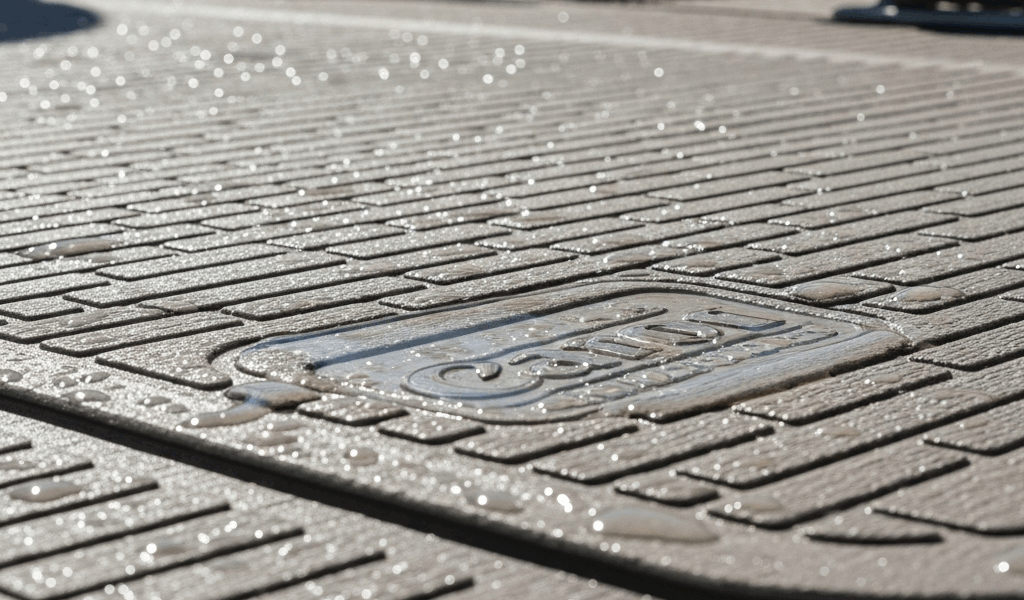
EVA Foam Mats — Best for Budget Lake Boaters
Most lake boaters ask the same question: which pontoon boat mat actually survives freshwater conditions without becoming a mildew factory by mid-summer?
EVA foam—ethylene-vinyl acetate—comes in marine-grade densities between 45 and 60 kg/m³. That’s the sweet spot for deck matting. Why? Because density determines how much water the foam absorbs. Here’s where it gets counterintuitive: EVA absorbs freshwater faster than saltwater. Osmotic pressure differences explain it. Freshwater lacks the dissolved salts that create osmotic barriers, so water molecules penetrate EVA cell structures more readily. Not inherently bad—just reality you’re managing.
Decent EVA mats run $8 to $16 per square foot. You can find cheaper options, sure, but those are typically 35–40 kg/m³ density—basically compressed sponges that compress permanently after one season of foot traffic. The 50 kg/m³ sweet spot costs around $12 per square foot and will last two to three seasons in direct sun before UV degradation makes the surface chalky and slippery.
Probably should have opened with this section, honestly: mildew is the real killer for EVA in freshwater dock storage. Without proper ventilation, mildew blooms within 6 to 8 weeks. I watched a pontoon owner in Minnesota store his boat with the mat still bonded to the deck in an unventilated cabin. By August, the mat was a black-spotted disaster. He’d used standard polyurethane adhesive—fine for initial bonding, but it didn’t allow the mat to breathe underneath. Big mistake.
Slip resistance when wet? Decent but not exceptional. EVA typically achieves a coefficient of friction around 0.50–0.60 when wet and clean. Add algae bloom from a warm, nutrient-rich lake, and you’re down to 0.35–0.40. That’s slippery. Not dangerous on a calm day—genuinely risky when the boat rocks or you’re moving fast across the deck.
- Typical lifespan: 2–3 years in direct sun
- Mildew risk timeline: 6–8 weeks in humid dock storage without ventilation
- Cost: $8–$16 per square foot
- Adhesive type: Polyurethane or contact cement (freshwater-specific, not saltwater formulations)
- Maintenance: Annual pressure washing, mildew treatment with dilute bleach
Marine-Grade Rubber Mats — Premium Durability Choice
Frustrated by the failures I’d witnessed with budget EVA, I tested EPDM rubber mats on my own pontoon. EPDM—ethylene propylene diene monomer—is what you actually want. Not natural rubber, which deteriorates in freshwater UV exposure, and definitely not SBR, which is cheap synthetic that turns into cracked rubber within two years.
EPDM resists freshwater algae bloom significantly better than EVA. The rubber polymer itself is chemically resistant to organic compounds that algae secrete. EVA foam is porous—those algae compounds soak in and create a breeding ground. EPDM is non-porous, so algae sits on the surface where you can wash it off. That’s the difference that matters.
Cost premium is real. EPDM mats run $18 to $28 per square foot—roughly double EVA. Rental pontoon fleets and resort operators choose EPDM specifically because they replace mats every five to seven years instead of every two to three. The math eventually favors rubber when you’re managing dozens of boats.
Lifespan in a lake environment is genuinely 5–7 years. I’ve seen original EPDM mats on rental pontoons after six seasons that look visibly faded but remain structurally sound and slip-resistant. That’s not marketing—that’s fleet maintenance data.
Slip performance when wet and algae-slick is superior. EPDM typically hits 0.65–0.75 coefficient of friction even when algae-coated, because the rubber surface is raised and textured, not smooth like compressed foam. You feel the difference immediately the first time you walk on wet EPDM versus wet EVA.
Maintenance burden is lighter with rubber. Pressure wash once or twice a season. No mildew treatment needed because rubber doesn’t absorb water. No annual bleach soaks. You’re just keeping the surface clean.
Weight becomes the tradeoff here. EPDM mats are heavier—roughly 40–50% heavier than equivalent EVA—so if you’re removing your mat for winter storage in a cold climate (which you should), hauling an EPDM mat off the dock becomes an actual task.
Polypropylene Woven Mats — Lightweight Alternative
Woven polypropylene mats don’t absorb water because the material is thermoplastic resin woven into a lattice structure, not foam or rubber. Water runs right through the weave and drains away. Sounds ideal until you’re standing on a wet polypropylene mat and realizing you’re basically standing on a wet rope ladder.
Slip resistance is the real weakness here. Polypropylene achieves roughly 0.40–0.50 coefficient of friction when wet—similar to or worse than a wet EVA mat. On a pontoon deck where crew members are moving between the helm and the bow while the boat rocks, that’s marginal at best.
Temperature resilience in freshwater thermal cycles is actually excellent. Polypropylene doesn’t become brittle in cold or mushy in heat the way foam can. Spring warming and winter freeze-thaw cycles don’t degrade the material significantly. That’s why you see woven mats used on docks and in RVs across climate zones.
UV stability is longer than EVA but shorter than EPDM. Polypropylene typically survives 3–4 seasons before the weave becomes tacky and the color fades to dull gray. Cost sits in the middle: $12–$18 per square foot.
The failure case I’ve observed repeatedly: woven mats on high-traffic pontoon decks. Crew moves quickly across the deck in wet conditions, feet slip through the lattice, someone grabs for stability and pulls a muscle or falls into another passenger. It happened on a charter pontoon I worked on in the Northwoods. The mate switched to EPDM the following season and never looked back.
Woven mats excel in low-traffic applications—the bow area where you’re sitting, not where you’re walking quickly. For main deck traffic patterns on a pontoon, weight savings aren’t worth the grip penalty.
Lake-Specific Installation and Maintenance
Installation decisions matter more than most pontoon owners realize. Adhesive choice for freshwater is fundamentally different from saltwater adhesive. Freshwater adhesives need to allow vapor transmission underneath the mat, or you’re creating a moisture trap. Marine polyurethane adhesive designed for saltwater applications often lacks this breathability because saltwater applications prioritize water impermeability. Freshwater pontoons need contact cement or specifically formulated freshwater polyurethane that allows the substrate to breathe.
Ventilation requirements for mildew prevention are non-negotiable. Pontoons stored on docks are moisture traps—especially if the boat is covered. Ensure your mat can breathe underneath by using an adhesive with breathability properties, or dry-fit the mat without adhesive and secure it with fasteners only. Sounds unstable, but marine adhesive tape rated for freshwater — 3M 5200 or equivalent — creates a breathable bond that still holds.
Seasonal removal strategy depends on your climate. In cold lakes where water freezes, removing the mat before winter prevents freeze-thaw damage at the adhesive bond line. Ice expansion under the mat cracks EVA and loosens rubber. Remove mats by late October if you’re above the 40°N latitude. Warm lakes below 35°N can leave mats on year-round.
Cleaning protocol for algae removal without damaging material: pressure wash at or below 1500 PSI. Higher pressure fragments EVA foam and can delaminate rubber at the seams. For stubborn algae, use a soft-bristle deck brush with dilute white vinegar before pressure washing. Avoid bleach on colored EPDM—it fades the pigment.
Which Mat for Your Lake and Season
Decision framework comes down to three variables: lake location, usage pattern, and actual budget.
In a warm, algae-heavy lake in the South or Midwest where you store your pontoon on a dock? Marine-grade EPDM wins despite the $150–$200 premium. EVA will mildew in 8 weeks without perfect ventilation—and most dock storage lacks it. I’d rather spend $500 more upfront than replace a mat every two years and fight mildew seasonally.
Day-cruiser in a cold, clear lake with winter storage in a garage—meaning the mat comes off the deck November through April? EVA is defensible. You’re reducing the mildew timeline by removing the mat from the moisture-trapping dock environment. Annual maintenance becomes manageable.
Portability paramount and you’re confident in your foot placement in wet conditions? Polypropylene works for the bow seating area only. Don’t put woven mats in high-traffic helm or walkway zones.
Honest recommendation: If you’re asking this question, EPDM is the answer. It costs more, but it eliminates the mildew gamble, lasts three times as long, and feels safer underfoot when conditions turn wet. That’s the margin that justifies the investment for someone who actually uses their pontoon regularly.
Deck flooring is different from a recreational float. If you mean a pad that unrolls on the water, use our floating lake mat buying guide.




Stay in the loop
Get the latest sail the seas mag updates delivered to your inbox.