Why Fuel Tank Contamination Happens on Sailboats
Sailboat engine fuel tank contamination—it’s the silent threat that keeps offshore cruisers awake at night. I learned this the hard way during my second season of extended coastal cruising, when a neglected fuel tank turned a simple motor into port into a three-day ordeal. My mechanic didn’t understand why I was panicking about brown water in my fuel bowl. Turned out I had every reason to panic.
Marine fuel tanks face conditions that land-based storage simply doesn’t. Your boat breathes constantly. As you motorsail through temperature swings—say from 75°F at noon to 62°F by midnight—the air inside your tank contracts and expands. This movement forces moist air in and out through the breather cap. That moisture condenses on the tank walls and collects as actual water in the lowest points. It’s physics, and you can’t fight physics.
Diesel fuel in particular invites microbial growth. Bacteria and fungi thrive in the interface between fuel and water, especially when you’re anchored for weeks in warm, humid climates. The fuel becomes their home. They feed on diesel, producing acidic byproducts that corrode tank walls and create sludge. Lovely stuff.
Sediment settling is another persistent problem. Every fuel dock has its own supply. Some marinas have excellent water-maintenance systems; others don’t—I’ve learned this the hard way. Small particles of rust, dirt, and oxidized fuel byproducts enter your tank during refueling. Over weeks of motoring through swells, these particles settle to the tank bottom. Temperature fluctuations also accelerate fuel degradation—oxidation happens faster when fuel cycles through 40-degree temperature swings repeatedly.
Then there’s the cruiser’s dilemma. You motor regularly but not excessively—typical for bluewater sailors who might run the engine 2-3 hours daily for battery charging—and your fuel sits partly unused. That unused portion ages. After 6-12 months, fuel can develop varnish and gum deposits even without water or biological contamination.
Signs Your Sailboat Fuel Tank Is Getting Contaminated
Caught early, fuel contamination is manageable. Caught late, it’s a disaster offshore. Here’s what to watch for.
Engine hesitation under load. You’re motorsailing upwind, the engine bogs down momentarily when you push throttle, then recovers. This typically means sediment or particulates are intermittently blocking fuel flow. If it happens only once, it’s probably debris. If it’s becoming frequent—that’s when you pay attention. Your fuel system is compromised.
Black or dark gray smoke on cold startup. A small puff is normal. Sustained black smoke for 10-15 seconds? That indicates fuel degradation and incomplete combustion. Could be varnish buildup in the injectors. Could be water-contaminated fuel that’s burning poorly. Either way, something’s wrong.
Fuel filter clogging in quick succession. You replaced your primary fuel filter two weeks ago. Now it’s clogged again. This is sediment or microbial growth creating a rapid paste-like substance. It’s your warning that the tank itself needs attention. Don’t ignore it.
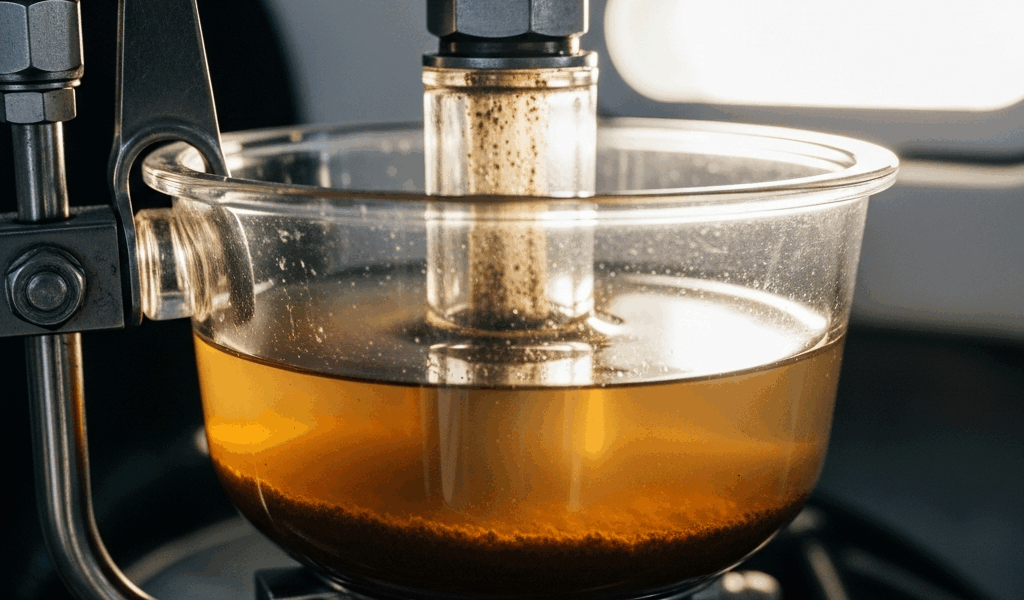
Water visible in your water separator bowl. This is the clearest early indicator. Even small amounts—say 1-2 tablespoons in the bowl—mean condensation or contamination is happening. Significant water (more than a quarter-inch in the bowl) means the tank is breathing moisture daily or you have a fuel system leak.
Fuel smell like old varnish or rotten fruit. Biological growth produces distinctive smells. When you open the fuel filler cap and smell something that isn’t clean diesel, you have a problem. Varnish smell is oxidation; rotten fruit smell is microbial activity.
Probably should have opened with this section, honestly. These warning signs are what actually matter to most sailors. Prevention fails sometimes. Early detection saves you from sitting dead in the water.
Prevention Steps Before Leaving the Dock
Start with fuel sourcing. Not all diesel is equal. Reputable marinas with high turnover—the kinds where fishing boats and water taxis fuel regularly—have fresher fuel. Avoid remote anchorages or seasonal marinas where fuel sits in above-ground tanks during winter. Ask the fuel dock manager directly: “When was this tank last filled?” You might get a vague answer, but sometimes you’ll get useful information.
Use fuel stabilizer religiously. Products like Biobor JF or Fuzzbuster are worth every penny. A standard 55-gallon tank gets a one-quart bottle of stabilizer when you fuel up. The cost is roughly $8-12 per refueling. This stabilizer inhibits microbial growth and slows oxidation dramatically. I’ve gone from fuel filters clogging every three weeks to every three months using stabilizer consistently. It’s the single best investment I’ve made.
Ensure tank ventilation works properly. Your fuel tank breather cap—usually located near the main fuel filler—should have a filter element. If it’s clogged or missing, replace it. A clogged breather forces pressure changes that suck moisture and contaminants directly into your tank. Check the breather quarterly. On a recent crossing, I discovered mine was blocked by spider webs and salt crystals. Five minutes of cleaning prevented what could have been a serious problem.
Change your fuel filters on schedule, not waiting for symptoms. Primary filters (before the water separator) should be replaced every 300-500 engine hours or annually, whichever comes first. Secondary filters, every 200 hours. This is insurance, plain and simple. An inexpensive element costs $15-30. Engine repair costs thousands.
Implement a fuel-settling period before extended passages. If you refuel a day or two before departing, particles and moisture have time to settle. Run the engine gently—no load—for 15-20 minutes. This allows any condensation from the refueling process to collect at the tank bottom rather than being distributed throughout the fuel system. Check your water separator bowl afterward. If water appeared during settling, you know to address it before the ocean.
Fuel age matters for cruisers more than recreational boaters. Buy fuel for your trip when possible, not months in advance. If you’re planning a long passage and need to store fuel, keep it cool (below 70°F if possible) and dark. Some cruisers use portable jerry cans rather than filling the main tank, rotating stock more frequently. Yes, jerry cans add weight. They also add peace of mind.
Monitoring and Maintenance While Cruising
Once you’re offshore, visual inspection becomes your diagnostic tool. Keep a clear sample bottle—a simple 12-ounce plastic bottle from any beverage, rinsed thoroughly—in your galley. Once weekly, take a fuel sample directly from the fuel tank through the inspection port or by drawing a small amount through the primary fuel filter drain valve. Hold the bottle up to sunlight or a bright lamp. You’re looking for color and clarity.
Clean diesel is pale golden-amber. Brown fuel indicates oxidation. Dark brown or black indicates sediment or microbial growth. Cloudy appearance suggests water emulsion. Visible particles—you’ll see them floating—mean sediment. Any deviation from pale amber warrants action.
Water separator maintenance is critical during passages. Check the bowl every five days. More frequently in humid or tropical anchorages—every two days is reasonable. A manual water separator (the most common type on sailboats) has a bowl at the bottom that collects water. Open the drain valve slowly, letting water drain into a cup. Even a tablespoon is significant; drain it completely. Close the drain valve firmly—loose drain valves are a common cause of fuel leaks.
Biocide use: run it if you suspect biological growth, not as prevention. Products like Fuzzbuster or Biobor JF work best when fuel is actively circulating. Before an offshore passage, if your fuel smells questionable or you’ve experienced recent fuel filter clogging, add biocide according to the label (typically one dose per 100 gallons), run the engine under load for 30-45 minutes, then wait 24 hours before departure. The biocide kills microbial populations. The engine running circulates it through the fuel system.
For passages exceeding 10 days, plan for fuel filter changes mid-passage if your boat is equipped with secondary filters accessible underway. A seasoned cruiser I met carries three extra fuel filters. On a three-week passage to the Caribbean, he changed his filter once—peace of mind for $25 and 10 minutes of work.
Emergency Troubleshooting if Contamination Occurs at Sea
Your engine is hesitating, fuel filters are clogging, and you’re 200 miles from the nearest port. Here’s what works.
Switch fuel tanks if equipped. Many cruising sailboats have dual fuel tanks or a main tank and auxiliary system. If one tank is contaminated, the other may be clean. Switch immediately and monitor the secondary tank. This buys you time to reach port under sail if necessary.
Emergency filtration. If you have only one tank, you can rig temporary high-efficiency filtration. Some cruisers carry 10-micron spin-on filters or even mechanical fuel filters normally used in trucks. These can be adapted to your system temporarily with barbed fittings and hose. It’s literally a bandage, not a fix, but it works for 24-48 hours of motoring to reach port.
Run the engine sparingly. If contamination is severe, use your engine only for battery charging and essential maneuvering. This reduces fuel circulation and prevents plugging multiple fuel filters. Plan your passages under sail whenever possible. I’ve made harbor under full canvas while waiting for fuel system repair—not comfortable, but it works.
Know when to head to port. If your fuel filter is clogging every 2-3 hours of motoring, you cannot reach your intended destination safely. Head to the nearest port, even if it’s not on your route. A 200-mile diversion to a fuel dock where you can address the problem is better than stranding yourself with a non-functioning engine. A friend’s fuel tank contaminated badly on a passage toward the Bahamas. She diverted to Beaufort, North Carolina—60 miles off-course—had her tank cleaned professionally, and continued. Delayed by three days. If she’d ignored it, she’d have drifted helpless.
Prevention is genuinely cheaper than treatment. But when contamination happens anyway—and eventually it will—early detection and rational decision-making keep you safe and your engine functional.



Stay in the loop
Get the latest sail the seas mag updates delivered to your inbox.